Another new Brexit thread

  • Thread starter Thread starter Ric
  • Start date Start date
Status
Not open for further replies.
Good luck getting a private member's bill through our Parliament without government support. And JohnCummingsSon would like to make it more difficult.
Is that the best you can do with a question of democratic legitimacy in the EU parliament?
The essence of democracy is that the laws of the land have the consent of the ppl, because their reps create them. Legislative power in the EU rests primarily with unelected civil servants, the Commission.
 
Independence rule number one - don't take any notice of USA created rankings of anything
Well I'd be interested to know where the numbers are from then.

Use just a little critical thinking and the idea that Germany or France don't have a single university in the top 40 of the world becomes absurd
 
Look, I am not defending the EU and there's much that's wrong with it. I was very mixed about whether we should stay in or leave.

But the above is a combination of IMO a rather biased perspective and also misunderstanding.

Yes, the EU Commission is responsible for bringing forward legislation. But how different is that from the situation in the UK where the government is responsible for bringing forward virtually all legislation? Sure our government is elected, but is it limited to only legislating on things in its manifesto? No. Is it obligated to bring forward legislation for things that were in the manifesto? No. All it has to do is get elected and then it can rather undemocratically, do what it likes in terms of the legislation it chooses to bring forward, or not.

Even if you do not agree with this comparison, there's then the point that the EU Parliament can request the Commission to bring forward legislative proposals. Practically speaking, no such facility exists in our own democracy. (Yes there are private members' bills and what-have-you but the practical opportunities for those to become law are virtually nil.) And whilst you are correct that the Commission is not obligated to act Parliament's requests and can in theory refuse, as far as I am aware that has never happened.

Finally, what you say about there being nothing Parliament can do, is incorrect. The EU Parliament is ultimately sovereign. If the Commission were to refuse, Parliament can pass a censure motion and remove the commission and its commissioners if it wants to. Ultimate power lies with the elected Parliament.

It is claimed that the EU Parliament is simply a rubber-stamping body, given the amount of Commission proposed legislation which is passed. But in reality this is not the case. Yes, Parliament does pass most of the legislation but that is because it supports most of it. Were that not the case, it is free to reject proposal, amend them or ask the Commission to redraft and re-submit. It's not obligated legally, morally or otherwise to bring into law anything which the Commission brings forward.

So honestly, it's really not undemocratic at all. It's just not the same as our democracy. Which as you know also has an unelected body which is able to influence the laws we are subjected to!
Fair enough, but comparison to our own failings is not justification! In any case, we have more mechanisms than a private members bill e.g. opposition days, the ability to challenge in the courts (Gina Miller), the Law Commission to name a few.


Glad I will be in that square tomorrow night rather than parliament square, looks like their gracious goodbye will be classier than some of the triumphalistic shite over here.
 
The point is though that we - the UK population - have not voted to be part of an EU superstate

We - the UK electorate - have been promised to have a vote on treaties that advance that destination - and have been lied to

We - the UK electorate - when eventually given the option to vote have rejected that direction.

It will be interesting to see the revisionism on here - when I was making such posts years ago pointing out the remorseless and unavoidable destination of the EU I was told that I was in fantasy land

Now it is - yeah we knew all that and supported it....

IMO - some proper bollocks was posted by Remainers then - and there continues to be a similar level now - just different flavour

Pure revisionism (not just from you); it's there in all the "if only it had just been about trade" posts and variants.

The idea that the 1975 referendum was merely about trade is just wrong. From the Times on the day:
"We can either Join in the general work of building a strong and generous Europe, or we can try to build a strong Britain on our own. There was also of course a practical as well as an idealist debate. This was indeed the debate which the Prime Minister himself conducted. The question he put was whether the United Kingdom could better advance her prosperity on her own or as a member of the Community, and he was able to make the case quite convincingly that Britain would be better able to look after her prosperity as a member of the Community and should, therefore, make the European choice on the simplest grounds of self interest. Mr Wilson throughout professed not to be moved by a European idea, but to be looking at such matters as jobs and prices for Britain; in taking this line he may have done his best for the "Yes" vote by somewhat understating his own sense of vision. European idealism puts a more fundamental and a more interesting question than that. It invites us to accept and to develop a loyalty to our Continent as well as to our island and invites us to see our self interest as involving the collective interest of a group of nations working together for purposes of European development. There is also in it the belief that the history of Europe is the story of a single human civilization in which we are all citizens. There is the belief, which must seem odd to a Chinaman, that the European civilization is the finest the world has known, and the most liberating for mankind." https://www.thetimes.co.uk/archive/article/1975-06-05/15/1.html

Margaret Thatcher (HoC debate, 08 April 1975):
"The paramount case for being in is the political case for peace and security. It is taken for granted now that Western Europe, which has been the centre of troubles within our lifetime, will not embark again upon its own destruction. I think that we should not too readily take that for granted but for the tremendous efforts and constructive purpose which have led to those nations working together in the Common Market.

"One of the measures of the success of the Community that we now take for granted is essentially security. I think that security is a matter not only of defence but of working together in peacetime on economic issues which concern us and of working closely together on trade, work and other social matters which affect all our peoples. The more closely we work together in that way, the better our security will be from the viewpoint of the future of our children."

In that one speech she rehearsed all the arguments made these last years for Remain, and dissed some of the nonsense about (e.g.) trading with the Commonwealth:
"Traditionally, Britain has always been part of a larger grouping, and was listened to partly because of that grouping as well as because of our own particular attributes. It used to be the Commonwealth, but since then most of the Commonwealth countries have become independent and have set up their own trading preferences and arrangements. That did not happen only after our accession to the Common Market. For years and years the Commonwealth preferences were being eroded, as those of us who tried to sell to many of the Commonwealth countries knew. Naturally, they set up their own industries, and naturally they protected them in the early stages. That meant that steadily our markets were closing down. I watched that process year after year. It became vital that as those markets closed down, so we should be able to open up markets of equivalent or greater capacity elsewhere."

I have no doubt you'd call this deflection and that she didn't understand....:
"We knew what we were going into because of the careful negotiations. If we withdraw we have no idea of what alternative trading arrangements we shall be able to secure. Quite a number of people have made a different suggestion, that perhaps we could return to EFTA. We are already a member of the free trade area by virtue of being a member of the Common Market; and if we were out every EFTA country would have to secure EEC permission because of the free trade agreements. Secondly, we would be a market of only 40 million, which is hardly comparable to a market of 200 million in the EEC. Thirdly, agreements on EFTA are particularly tough on rules of origin, and those in themselves, in the way they operate, could have an adverse effect on some of our trade, particularly in motorcar components." And that was rejoining EFTA - not some made leap into No Deal. I'd love to see you telling Thatcher that we'd only get a good deal if we had the political will to threaten to leave with no deal.

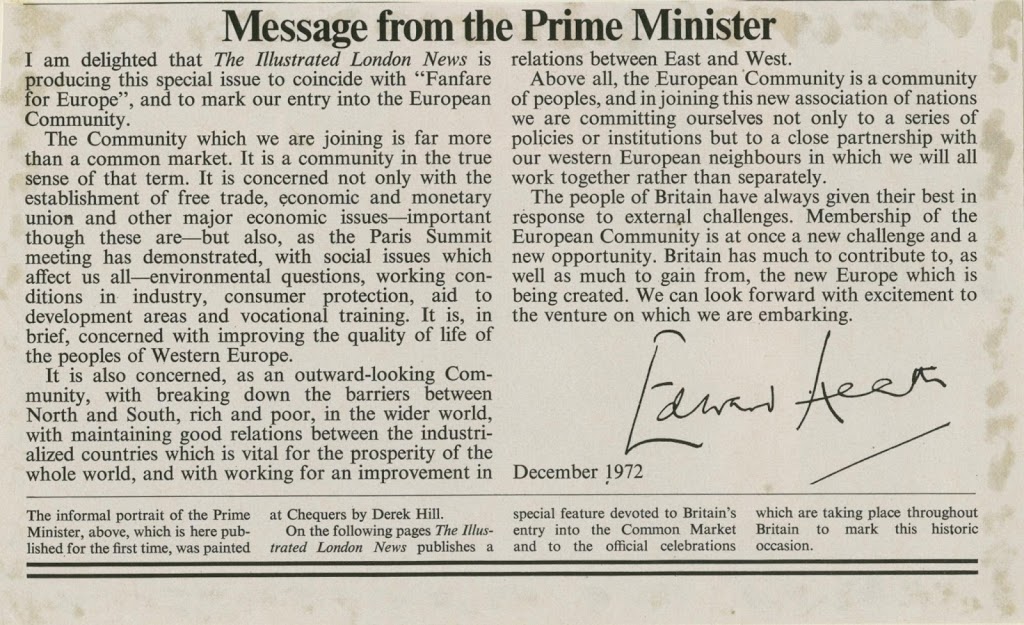
Ted Heath on joining "more than a common market":

1973Jan01-2-.jpg
 
Not correct. All three arms have the ability to raise legislation and most (all?) States have the proposition system, where ppl can force legislature to act. They also can challenge in the courts.
The US Judicial branch cannot raise legislation, only interpret legislation already passed via suits that raise edge cases for or challenges to already passed legislation.

And the Executive branch must funnel all proposed legislation through their proxies in the Senate or House of Congress, with those proxies “sponsoring” any legislation to be considered by first subcommittees, then commitees, then one chamber, then the other (and often both, if the legislation ever gets that far).

Only the Legislative branch can truly propose legislation, and even that is fairly difficult now for the reasons listed above. Most proposed legislation never makes it out of committee these days, and what does rarely gets passed by the chamber from which it originated. Because the Congress is split — Democrats holding the House and Republicans holding the Senate — most legislation passed by one chamber gets dismissed in the other. Or changed so much that the originating chamber no longer wishes to take it up.

That problem has always existed in the US and other democratic nations but it has gotten much worse in the last few years as partisan politics have truly taken hold, obliterating compromise.

The US states generally have the same or very similar systems as the federal one, though you are right that many have ballot proposition mechanisms that allow their citizens to directly propose policies, laws, or revisions to current laws via ballot. However, many states, mostly via Republican led initiatives, have made getting a proposition on the ballot incredibly difficult.


Well we know what it is now, but the question is what the end point is.
I worked there for three years and all the movers and shakers were convinced that a superstate was the terminus. Obvs, some of the smaller countries are opposed, fearing French and German dominance. Coincidently, France is currently engaged in telling Poland how to appoint judges...

Do you support what the Polish government wants to do to their judiciary?
 
Is that the best you can do with a question of democratic legitimacy in the EU parliament?
The essence of democracy is that the laws of the land have the consent of the ppl, because their reps create them. Legislative power in the EU rests primarily with unelected civil servants, the Commission.
But the whole idea of creating a federal model (which seems decades away from any possibility in the real world) would involve creating democratic institutions as part of it.
 
The US Judicial branch cannot raise legislation, only interpret legislation already passed via suits that raise edge cases for or challenges to already passed legislation.

And the Executive branch must funnel all proposed legislation through their proxies in the Senate or House of Congress, with those proxies “sponsoring” any legislation to be considered by first subcommittees, then commitees, then one chamber, then the other (and often both, if the legislation ever gets that far).

Only the Legislative branch can truly propose legislation, and even that is fairly difficult now for the reasons listed above. Most proposed legislation never makes it out of committee these days, and what does rarely gets passed by the chamber from which it originated. Because the Congress is split — Democrats holding the House and Republicans holding the Senate — most legislation passed by one chamber gets dismissed in the other. Or changed so much that the originating chamber no longer wishes to take it up.

That problem has always existed in the US and other democratic nations but it has gotten much worse in the last few years as partisan politics have truly taken hold, obliterating compromise.

The US states generally have the same or very similar systems as the federal one, though you are right that many have ballot proposition mechanisms that allow their citizens to directly propose policies, laws, or revisions to current laws via ballot. However, many states, mostly via Republican led initiatives, have made getting a proposition on the ballot incredibly difficult.
By all three arms, I meant HoR, Senate and President, tho I take you point about the pres. needing sponsorship.
 
But the whole idea of creating a federal model (which seems decades away from any possibility in the real world) would involve creating democratic institutions as part of it.
Yes, it would, but not a reason not to try.
 
Fair enough, but comparison to our own failings is not justification! In any case, we have more mechanisms than a private members bill e.g. opposition days, the ability to challenge in the courts (Gina Miller), the Law Commission to name a few.
Not if JohnCummingsSon gets his way on hobbling the UK judiciary.
 
By all three arms, I meant HoR, Senate and President, tho I take you point about the pres. needing sponsorship.
Ahh, I thought you were referring to the world renowned “three branches of government” with the reference.

At any rate, the US legislative apparatus is currently nearly nonfunctional.
 
Ahh, I thought you were referring to the world renowned “three branches of government” with the reference.

At any rate, the US legislative apparatus is currently nearly nonfunctional.
I should have been clearer. It is often in a state of deadlock, which can be frustrating no doubt, but they don't have any problems with elected dictatorship
 
I should have been clearer. It is often in a state of deadlock, which can be frustrating no doubt, but they don't have any problems with elected dictatorship
Nor seem do many of us, even ignoring the EU. ;-)
 
Status
Not open for further replies.

Don't have an account? Register now and see fewer ads!

SIGN UP
Back
Top