Will his "reward" be at FMV? I think he deserves at least a fiver.Give the red cartel chance to see how 115 turns out then Mr M can take the full blame for carrying out their instructions.
In return they will ensure he is financially rewarded.
Their line will be we thought he was the ideal person but City insisting on pedantic compliance with the UK legal system simply overwhelmed his best intentions. We wish him well in his future business ventures.

You are using an out of date browser. It may not display this or other websites correctly.
You should upgrade or use an alternative browser.
You should upgrade or use an alternative browser.
City launch legal action against the Premier League | Club & PL reach settlement | Proceedings dropped (p1147)
- Thread starter denislawsbackheel
- Start date
Thanks again - saved me trawling through!
I'm not sure the last paragraph holds together grammatically, but the meaning's clear. It sounds like one of City's side-arguments (among several) that didn't prevail but they had others enough to win the overall argument. That still leaves the gap between City's participation in the group that helped formulate "the Recommendations" (including FMV) then voting against the rule changes based on the Recommendations. What changed? Or what did the PL change?
(I may well have missed something else...!)
But I'm still surprised that severance never cropped up in the first hearing:
From the second judgment (APT2):
7. In this further arbitration hearing the Club has sought a declaration that the effect of the
declarations issued by the Tribunal is that the APT Rules as a whole, and the Amended APT
Rules (that is to say Rules E.55-79) are void and unenforceable on the basis that the three
respects in which the APT Rules and the Amended APT Rules were found to be unlawful
cannot be severed with the result that the APT Rules as a whole and the Amended APT
Rules are void and unenforceable.
8. The effect of the declarations issued by the Tribunal was not an issue at the June Hearing
and so the first Partial Final Award did not deal with it.
Presumably all the lawyers were aware of the severance precedents and City could have sought a declaration, yet we ended up with a dispute that needed another hearing. It just seems such a fundamental difference of outcome that it could and should have been addressed first time round - then even if the Tribunal wanted to reserve judgment on the issue, City couldn't have claimed that the rules were void as an entirety from the outset, only might be.
deano ou812
Well-Known Member
Correct,but that idiot Wallace obviously doesn’t,or he does but it doesn’t fit with what he wants to wrongly get across..Magnificent reply from Colin to Wallace. The point about City continuing to comply with the UEFA rules kills his story.
Big mals fedora
Well-Known Member
- Joined
- 12 May 2013
- Messages
- 911
As opposed to one of his , generally, best bummings ??!!!….:-)One of PB’s best written bummings this.
Prestwich_Blue
Well-Known Member
And I'm followed by a Lord as well! Blimey.One of PB’s best written bummings this.
They've got themselves in a right pickle.There has been no scrutiny of why the PL leadership want to have a totally different set of rules to UEFA. The PL doesn’t seem to care about excessive debt but rejects investment.
Thank you. I actually had in mind the "sports law specialists" who went along with the PL's claim to have won on some points rather than just say City got exactly what they'd asked for.
I have to ask: without any mention of separating out the offending rules in the pleading recorded by the Tribunal in its (APT1) judgment, isn't the obvious conclusion (from s.2 of the Competition Act) that if the rules were unlawful, they were prohibited and therefore the agreement to change the rules was void. (As City told the other clubs, and I tried to explain on here.)
This was asked of me, so I put together a quick explainer. A bit rushed, but if I've misunderstood what you wanted to know or if it's unclear, tell me and I'll have another go. Also, not meaning to patronise you. One or two things are aimed at also helping readers who may not understand the issue in the way I know you do.
If only certain provisions in an agreement are void under the Competition Act 1998 and they are capable of being severed from the rest of the agreement, then the remainder of the agreement may be enforceable. The ordinary rules of severance apply. The doctrine of severance in contract law basically allows an illegal or uncertain contractual provision or even part of one to be removed from a contract, while the validity of the remaining provisions is preserved.
The Supreme Court considered the issue in 2019 in the case of Egon Zehnder Ltd v Tillman. In doing so, the Court overruled existing case law and developed a new test for severance of offending contractual provisions to be permitted, and it applies to provisions in agreements (and the PL's rules have contractual force) as follows: first, the words that will be severed must be capable of being removed without the need to add to or modify the remainder; and second, the removal of those words should not generate any major change in the overall effect of the agreement.
Of course, what constitutes a “major change” is rather subjective and there's scope for considerable argument. It wasn't inevitable that City would win on that point in APT 1, but I thought that the arguments insofar as it was possible for us to tell from outside looked pretty good for us and the club evidently did win. If City prevail in APT 2, meanwhile, then severance would operate so that there'd be a fucking great big hole where the shareholder loans provisions should be. Usual disclaimers apply, bard for me to see how that wouldn't be a "major change", TBH.
Kazzydeyna
Well-Known Member
- Joined
- 5 Oct 2009
- Messages
- 3,149
That’s not true.Stefan, he’s a fucking liar. Your insight into the law is amazing but you are naive when it comes to the honesty of people.
Every day there are liars all lying as if they are warming up for the world fucking liar championships.
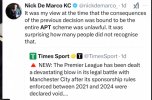
PB gave the pathetic blister an earful on X
This was applauded by Lord Goddard of Stockport
Did Sam reply to PB?
HelloCity
Well-Known Member
oakiecokie
Well-Known Member
To be fair he is gay ... Lord of the Rings ;;)And I'm followed by a Lord as well! Blimey.
Big Joe Corrigan
Well-Known Member
- Joined
- 3 Feb 2014
- Messages
- 4,806
Which reminds me, does Gaylord Dubois still post on here?To be fair he is gay ... Lord of the Rings ;;)
Chris in London
Well-Known Member
- Joined
- 21 Sep 2009
- Messages
- 13,900
NoIs that remedied by having a second hearing, though? Wouldn't that be conducted on the same issues as the first. Hence the need for a second arbitration to consider the November rules?
Isn't it more likely to be just procedural? That the tribunal and the parties agreed to two hearings: the first for the declaratory relief and the second for the rest? Same as with the 115 case, apparently?
Some issues which arise from the decision, like damages, are within the tribunal’s original remit. But there’s no point deciding on damages if the PL isn’t liable in the first place, hence the need for an additional hearing. If City had lost, there’s no need for a damages hearing.
Wider issues concerning the effects of the decision seem to have been beyond that remit, and the tribunal’s approach seems to have been “we will decide that if you want us to “.
halfcenturyup
Well-Known Member
- Joined
- 12 Oct 2009
- Messages
- 15,073
Yes, I saw his tweet. Did he say that at the time? He may have, but I don't remember it.
halfcenturyup
Well-Known Member
- Joined
- 12 Oct 2009
- Messages
- 15,073
No
Some issues which arise from the decision, like damages, are within the tribunal’s original remit. But there’s no point deciding on damages if the PL isn’t liable in the first place, hence the need for an additional hearing. If City had lost, there’s no need for a damages hearing.
Just trying to understand all this .... you know it's all complicated for me.
But can't you say the same about the null and void issue. There's no point deciding on null and void if the rules aren't unlawful in the first place, hence the need for an additional hearing? Or is there a difference?
MeatnSpudsMCFC
Well-Known Member
- Joined
- 8 Jul 2009
- Messages
- 12,547
In all this debacle it’s Newcastle I have most sympathy reserved for. Clubs like Arsenal and Liverpool were the architects of APT and then expect Newcastle to ship its best player (Isak) off to them as a result of those rules. It’s some top level entitlement and it’s rarely called out upon.
Small point and not directly related to City but I saw Carragher advocating for the transfer in the news. It’s just ridiculous the brass neck of it all.
Small point and not directly related to City but I saw Carragher advocating for the transfer in the news. It’s just ridiculous the brass neck of it all.
Having tried to catch up on the precedents for severance, I understood that you can't even change a "could" to a "would", you can only excise words, not add them. No doubt it's not that simple, but it still begs the question how they could get that far without the severance issue having been raised by either party, or reserved by the Tribunal.This was asked of me, so I put together a quick explainer. A bit rushed, but if I've misunderstood what you wanted to know or if it's unclear, tell me and I'll have another go. Also, not meaning to patronise you. One or two things are aimed at also helping readers who may not understand the issue in the way I know you do.
If only certain provisions in an agreement are void under the Competition Act 1998 and they are capable of being severed from the rest of the agreement, then the remainder of the agreement may be enforceable. The ordinary rules of severance apply. The doctrine of severance in contract law basically allows an illegal or uncertain contractual provision or even part of one to be removed from a contract, while the validity of the remaining provisions is preserved.
The Supreme Court considered the issue in 2019 in the case of Egon Zehnder Ltd v Tillman. In doing so, the Court overruled existing case law and developed a new test for severance of offending contractual provisions to be permitted, and it applies to provisions in agreements (and the PL's rules have contractual force) as follows: first, the words that will be severed must be capable of being removed without the need to add to or modify the remainder; and second, the removal of those words should not generate any major change in the overall effect of the agreement.
Of course, what constitutes a “major change” is rather subjective and there's scope for considerable argument. It wasn't inevitable that City would win on that point in APT 1, but I thought that the arguments insofar as it was possible for us to tell from outside looked pretty good for us and the club evidently did win. If City prevail in APT 2, meanwhile, then severance would operate so that there'd be a fucking great big hole where the shareholder loans provisions should be. Usual disclaimers apply, bard for me to see how that wouldn't be a "major change", TBH.
Chris in London
Well-Known Member
- Joined
- 21 Sep 2009
- Messages
- 13,900
It’s not at all unusual to have split hearings on liability and quantum. It permits a substantial costs saving if you successfully defend a case on liability without having to investigate quantum. But if you are claiming damages and you win on liability you still have to go through the second phase.Just trying to understand all this .... you know it's all complicated for me.
But can't you say the same about the null and void issue. There's no point deciding on null and void if the rules aren't unlawful in the first place, hence the need for an additional hearing? Or is there a difference?
But here the argument isn’t simply about liability and quantum. The question seems to have morphed from “did the PL fuck up” to “just how badly did the PL fuck up?” The club and the PL appear to have agreed that the panel should get to the bottom of how badly the PL fucked up even though it’s not strictly necessary in order to decide what damages City should have.
Nightmare Walking
Well-Known Member
- Joined
- 27 May 2014
- Messages
- 5,273
Only the uncouth need to resort to such vulgarities.Fuck off
oakiecokie
Well-Known Member
I`d forgotten all about him.Which reminds me, does Gaylord Dubois still post on here?