The point is though that we - the UK population - have not voted to be part of an EU superstate
We - the UK electorate - have been promised to have a vote on treaties that advance that destination - and have been lied to
We - the UK electorate - when eventually given the option to vote have rejected that direction.
It will be interesting to see the revisionism on here - when I was making such posts years ago pointing out the remorseless and unavoidable destination of the EU I was told that I was in fantasy land
Now it is - yeah we knew all that and supported it....
IMO - some proper bollocks was posted by Remainers then - and there continues to be a similar level now - just different flavour
Pure revisionism (not just from you); it's there in all the "if only it had just been about trade" posts and variants.
The idea that the 1975 referendum was merely about trade is just wrong. From the Times on the day:
"We can either Join in the general work of building a strong and generous Europe, or we can try to build a strong Britain on our own. There was also of course a practical as well as an idealist debate. This was indeed the debate which the Prime Minister himself conducted. The question he put was whether the United Kingdom could better advance her prosperity on her own or as a member of the Community, and he was able to make the case quite convincingly that Britain would be better able to look after her prosperity as a member of the Community and should, therefore, make the European choice on the simplest grounds of self interest. Mr Wilson throughout professed not to be moved by a European idea, but to be looking at such matters as jobs and prices for Britain; in taking this line he may have done his best for the "Yes" vote by somewhat understating his own sense of vision. European idealism puts a more fundamental and a more interesting question than that. It invites us to accept and to develop a loyalty to our Continent as well as to our island and invites us to see our self interest as involving the collective interest of a group of nations working together for purposes of European development. There is also in it the belief that the history of Europe is the story of a single human civilization in which we are all citizens. There is the belief, which must seem odd to a Chinaman, that the European civilization is the finest the world has known, and the most liberating for mankind."
https://www.thetimes.co.uk/archive/article/1975-06-05/15/1.html
Margaret Thatcher (HoC debate, 08 April 1975):
"The paramount case for being in is the political case for peace and security. It is taken for granted now that Western Europe, which has been the centre of troubles within our lifetime, will not embark again upon its own destruction. I think that we should not too readily take that for granted but for the tremendous efforts and constructive purpose which have led to those nations working together in the Common Market.
"One of the measures of the success of the Community that we now take for granted is essentially security. I think that security is a matter not only of defence but of working together in peacetime on economic issues which concern us and of working closely together on trade, work and other social matters which affect all our peoples. The more closely we work together in that way, the better our security will be from the viewpoint of the future of our children."
In that one speech she rehearsed all the arguments made these last years for Remain, and dissed some of the nonsense about (e.g.) trading with the Commonwealth:
"Traditionally, Britain has always been part of a larger grouping, and was listened to partly because of that grouping as well as because of our own particular attributes. It used to be the Commonwealth, but since then most of the Commonwealth countries have become independent and have set up their own trading preferences and arrangements. That did not happen only after our accession to the Common Market. For years and years the Commonwealth preferences were being eroded, as those of us who tried to sell to many of the Commonwealth countries knew. Naturally, they set up their own industries, and naturally they protected them in the early stages. That meant that steadily our markets were closing down. I watched that process year after year. It became vital that as those markets closed down, so we should be able to open up markets of equivalent or greater capacity elsewhere."
I have no doubt you'd call this deflection and that she didn't understand....:
"We knew what we were going into because of the careful negotiations. If we withdraw we have no idea of what alternative trading arrangements we shall be able to secure. Quite a number of people have made a different suggestion, that perhaps we could return to EFTA. We are already a member of the free trade area by virtue of being a member of the Common Market; and if we were out every EFTA country would have to secure EEC permission because of the free trade agreements. Secondly, we would be a market of only 40 million, which is hardly comparable to a market of 200 million in the EEC. Thirdly, agreements on EFTA are particularly tough on rules of origin, and those in themselves, in the way they operate, could have an adverse effect on some of our trade, particularly in motorcar components." And that was rejoining EFTA - not some made leap into No Deal. I'd love to see you telling Thatcher that we'd only get a good deal if we had the political will to threaten to leave with no deal.
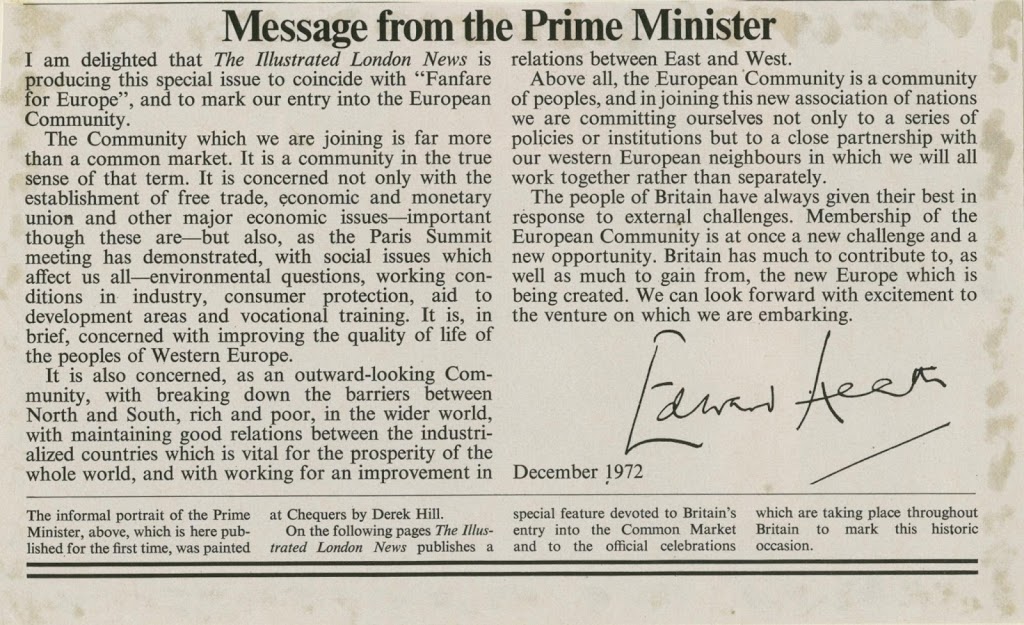
Ted Heath on joining "more than a common market":