Coronavirus (2021) thread

Status
Not open for further replies.
More stats on the Welsh vaccination programme (at least 1 dose):-

Over 80 - 90.5% vaccinated

75 - 79 years old - 92.6% vaccinated

70 - 74 years old- 91.4% vaccinated

Care home residents 84.4% vaccinated

Care home staff 85.8% vaccinated

Clinically most vulnerable (all ages) 84.3% vaccinated
 
I agree entirely, yet on social media this morning I am still seeing selfish twerps arguing the vaccines are a costly failure if 'all' they do is stop people getting very ill or dying. They will only be a success if they bring lockdown to an end and let everyone live their lives.

A bit like saying why should Boeing stop all 777s with this problem engine flying as they have. Fixing any problem is pointless if it means I don't get to fly on one this Summer.
It's staggering. Anyone complaining about how much the vaccines have cost ought to realise that the figure is dwarfed by how much this pandemic has cost so far.
 
Still blows my mind that they bunch Golf in with other sports.

BBC reporting the 29th March now for golf.. it should never have stopped!

Can only think it’s so they don’t have the knock on effect of allowing 1 sport and then people moaning why others aren’t allowed?
 
From BBC:

The first minister welcomes research led by Public Health Scotland found during the fourth week after the first dose, hospitalisations were reduced by 85% and 94% for the Pfizer and AstraZeneca jabs respectively.

"That is exceptionally encouraging news."

It is the first sign of the real world impact of vaccination in the UK.

Among the over 80s, there was an overall 81% reduction in the numbers admitted to hospital.
 
So, as predicted, the headline vaccine efficacy figures reported are somewhat misleading and the confidence intervals overlap massively.

At 4 weeks after one dose, efficacy reported.

Pfizer 76-91%, spot value 85%
AZ 73-99%, spot value 94%

Note that the AZ figure is based on just two(!) hospitalisations, the Pfizer on 18. The AZ confidence interval seems remarkably tight given it's based on only two patients, but OTOH I'm very sure they know their stats better than I do. The three week AZ figure is 72-90%, spot value 84%, based on 18 hospitalisations, which seems more soundly based.

Bottom line here is that both vaccines look very good at four weeks with a single dose, and can't be differentiated by this dataset.

Poor reporting to give the spot values, based on a poor press release which did the same, in my opinion.

They torture the data with myriad adjustments including age, sex, prexisting conditions, deprivation index and something to do with prior test results, none of which I really understand. If you just look at the base rate of hospitalisations with and without vaccine, they are far less impressive sounding, presumably because the most vulnerable are most likely to have been vaccinated.

The Pfizer one seems to drop off after 4 weeks, I've seen in claimed that may be an artefact of the low sample size.

 
We're going to beat this bloody virus..looking forward to getting my jab.
 
So, as predicted, the headline vaccine efficacy figures reported are somewhat misleading and the confidence intervals overlap massively.

At 4 weeks after one dose, efficacy reported.

Pfizer 76-91%, spot value 85%
AZ 73-99%, spot value 94%

Note that the AZ figure is based on just two(!) hospitalisations, the Pfizer on 18. The AZ confidence interval seems remarkably tight given it's based on only two patients, but OTOH I'm very sure they know their stats better than I do. The three week AZ figure is 72-90%, spot value 84%, based on 18 hospitalisations, which seems more soundly based.

Bottom line here is that both vaccines look very good at four weeks with a single dose, and can't be differentiated by this dataset.

Poor reporting to give the spot values, based on a poor press release which did the same, in my opinion.

They torture the data with myriad adjustments including age, sex, prexisting conditions, deprivation index and something to do with prior test results, none of which I really understand. If you just look at the base rate of hospitalisations with and without vaccine, they are far less impressive sounding, presumably because the most vulnerable are most likely to have been vaccinated.

The Pfizer one seems to drop off after 4 weeks, I've seen in claimed that may be an artefact of the low sample size.
Yep, seems a little misleading but still overall positive news.
 
So, as predicted, the headline vaccine efficacy figures reported are somewhat misleading and the confidence intervals overlap massively.

At 4 weeks after one dose, efficacy reported.

Pfizer 76-91%, spot value 85%
AZ 73-99%, spot value 94%

Note that the AZ figure is based on just two(!) hospitalisations, the Pfizer on 18. The AZ confidence interval seems remarkably tight given it's based on only two patients, but OTOH I'm very sure they know their stats better than I do. The three week AZ figure is 72-90%, spot value 84%, based on 18 hospitalisations, which seems more soundly based.

Bottom line here is that both vaccines look very good at four weeks with a single dose, and can't be differentiated by this dataset.

Poor reporting to give the spot values, based on a poor press release which did the same, in my opinion.

They torture the data with myriad adjustments including age, sex, prexisting conditions, deprivation index and something to do with prior test results, none of which I really understand. If you just look at the base rate of hospitalisations with and without vaccine, they are far less impressive sounding, presumably because the most vulnerable are most likely to have been vaccinated.

The Pfizer one seems to drop off after 4 weeks, I've seen in claimed that may be an artefact of the low sample size.


That’s why I said I thought they’d released it too early. The sample size for Pfizer after four weeks is still significantly larger than it is for AZ.

The Pfizer one, it’s going to be interesting to see over the next few months how much of an impact the delayed second dose has to the efficacy both in between and post second dose.
 
So, as predicted, the headline vaccine efficacy figures reported are somewhat misleading and the confidence intervals overlap massively.

At 4 weeks after one dose, efficacy reported.

Pfizer 76-91%, spot value 85%
AZ 73-99%, spot value 94%

Note that the AZ figure is based on just two(!) hospitalisations, the Pfizer on 18. The AZ confidence interval seems remarkably tight given it's based on only two patients, but OTOH I'm very sure they know their stats better than I do. The three week AZ figure is 72-90%, spot value 84%, based on 18 hospitalisations, which seems more soundly based.

Bottom line here is that both vaccines look very good at four weeks with a single dose, and can't be differentiated by this dataset.

Poor reporting to give the spot values, based on a poor press release which did the same, in my opinion.

They torture the data with myriad adjustments including age, sex, prexisting conditions, deprivation index and something to do with prior test results, none of which I really understand. If you just look at the base rate of hospitalisations with and without vaccine, they are far less impressive sounding, presumably because the most vulnerable are most likely to have been vaccinated.

The Pfizer one seems to drop off after 4 weeks, I've seen in claimed that may be an artefact of the low sample size.
yeah these are small sample sizes.

how do we square this off with that fact that ca. 750 85+ year-olds were being admitted to hospital per day in mid-Jan while in mid Feb this figure is now ca. 240 85+ year-olds per day? they've pretty much all been vaccinated. Whilst that is 66% reduction, a large amount of that is reduced caseload surely? there's something i'm not quite grasping here
 
178 England hospital deaths - was 231 last Monday.

Monday data always the lowest due to Sat/Sun non registrations.

14 from NW but they rarely are high over the weekend as they report even less than other regions do then.

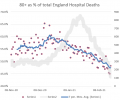
By the way for first time the two upper age ranges are just 1 death apart. Both under 50% too.
 
Would love to know which silly fucker as a government adviser has said “We can’t vaccinate our way out of this”. They’ve just undermined our vaccine rollout when people are already on edge. I could fucking cry, populace are been taken for complete mugs.
 
178 England hospital deaths by age:

20 - 39 (4) 2.2%

40 - 59 (17) 9.6% (11.8% is one of highest under 60 splits I recall)

60 - 79 (78) 43.9% (closest gap between two upper age ranges)

80 PLUS (79) 44.3% (lowest 80 plus number I recall)


These seem the best support yet in the daily numbers for a vaccine impact in the oldest age range.
 
Yep, seems a little misleading but still overall positive news.

Oh, absolutely it's positive. Very positive. Tremendous in fact.

I just get annoyed (1) by the need to keep comparing these vaccines which gives rise to fears that people might not be getting te "best" one and (2) The innumerate reporting of those spot values as if they mean anything in relative terms.
 
yeah these are small sample sizes.

how do we square this off with that fact that ca. 750 85+ year-olds were being admitted to hospital per day in mid-Jan while in mid Feb this figure is now ca. 240 85+ year-olds per day? they've pretty much all been vaccinated. Whilst that is 66% reduction, a large amount of that is reduced caseload surely? there's something i'm not quite grasping here

One thing the Israeli rollout seems to show is that the vaccine effect isn't seen as fast as you expect because the slowest vaccine takeup is in the areas which have the highest prevalence.

To translate to the UK: Areas with high poverty have high prevalence *and* low vaccine takeup. So you don't see as quick an impact as you'd expect if vaccine uptake were uniform across the country.

The tables in the paper on this show adjustments for these issues in deconvoluting the raw data back to the true vaccine effect.
 
One thing the Israeli rollout seems to show is that the vaccine effect isn't seen as fast as you expect because the slowest vaccine takeup is in the areas which have the highest prevalence.

To translate to the UK: Areas with high poverty have high prevalence *and* low vaccine takeup. So you don't see as quick an impact as you'd expect if vaccine uptake were uniform across the country.

The tables in the paper on this show adjustments for these issues in deconvoluting the raw data back to the true vaccine effect.

yeah thanks that's probably a good point.

other things i can think of;

- mid-Feb is still a bit early to see a very clear signal, if perhaps the effects dont really kick in for 4 weeks?
- hospitalisation occurs more readily the higher up the age brackets you go, possibly precautionary possibly needed, even if that does not end in serious illness
- there is more chance you have something else wrong with you at much older ages

which leads me to another qu generally to everyone - do the adjustments in the data for the reduction in serious illness by the vaccine include serious underlying health conditions? i.e. is that figure way way less if you have various illnesses (which are, sadly, more associated with old age?).

and obesity, a huge % of people in critical care were/are obese, i wonder if the vaccine is less effective at mitigating serious illness in obese people?
 
England hospital deaths 4 wks v 3 wks v 2 wks v last wk v Today:

609 / 54 NW / NW 8.9%

356 / 23 NW / 6.5% (42% total cases fall wk to wk)

313 / 23 NW / 7.3% (12 % fall wk to wk)

231 / 16 NW / 6.9% (26% fall wk to wk)

178 / 14 NW / 7.8% TODAY (23% fall wk to wk)
 
do the adjustments in the data for the reduction in serious illness by the vaccine include serious underlying health conditions? i.e. is that figure way way less if you have various illnesses (which are, sadly, more associated with old age?).

I think yes:

1614005571046.png
 
178 England hospital deaths by age:

20 - 39 (4) 2.2%

40 - 59 (17) 9.6% (11.8% is one of highest under 60 splits I recall)

60 - 79 (78) 43.9% (closest gap between two upper age ranges)

80 PLUS (79) 44.3% (lowest 80 plus number I recall)


These seem the best support yet in the daily numbers for a vaccine impact in the oldest age range.

The steady decline in o80s deaths in hospital as a % continues.

1614005717858.png
 
Status
Not open for further replies.

Don't have an account? Register now and see fewer ads!

SIGN UP
Back
Top