
You are using an out of date browser. It may not display this or other websites correctly.
You should upgrade or use an alternative browser.
You should upgrade or use an alternative browser.
EU referendum
- Thread starter Ric
- Start date
- Status
- Not open for further replies.

AlgarveBlu
Well-Known Member
- Joined
- 21 Aug 2005
- Messages
- 3,935
Its just too difficult. The 27 states will never be able to agree on the composition of the necessary institutions and voting procedures to make it a reality. It could only be achieved by a dictatorship.
Well then you're basically pinning the Uk's economic future on an ever decreasing economic block which makes most of the talk on here about potential future tariff levels outside of the eu irrelevant.
FanchesterCity
Well-Known Member
That's the whole leave point right there
Nobody is saying bring up the drawbridge except the right wing dickheads
All we are saying is...turn down the tap a little...make it harder for people to just come waltzing in...this country was built on immigrants...I'm proud of how multicultural we are...however we are a small country with limited resources and it doesn't matter how many good intentions you have...there's a time where things will reach critical mass...that time is near
Totally accept that, and what the remain camp are saying is - but how much are you prepared to pay for that? - because it's not for free.
Border clampdown? - who is paying for the extra staff? and who is going to run it properly, because it's already failed to police the illegal immigrants from outside the EU we DID have control over.
To the the 'control' we want, we have to leave the EU which will affect business. We (the remains) believe that is going to hurt us. We can't say precisely how much - even though some will try, but we're pretty confident it's going to hurt just based on simple logic - trade in the EU is smoothed by being members, trade is not smoothed by being out. 50% of our international trade is currently operating under 'smooth' mode. So changing to 'not smooth' is going to have a negative impact - which is increased prices or lost jobs, and it's makes the UK less attractive for businesses looking to enjoy the 'smooth' mode.
It's not going to kill business (though some smaller firms might go under). It's not going to stop trade or anything drastic like that. It's just going to increase cost for every single business that trades in the EU - every single one.
We just want leavers to understand that and appreciate some people will lose jobs in order for us to notionally gain back 'control', and the rest of us will have to pay more for some of our products.
That's before we get to any of the long term debates about which is best for the nation.
FanchesterCity
Well-Known Member
Well then you're basically pinning the Uk's economic future on an ever decreasing economic block which makes most of the talk on here about potential future tariff levels outside of the eu irrelevant.
If that block decreases significantly, then absolutely the tariffs become a moot point. The entire economic landscape across Europe will be thrown wide open, from which we stand to lose or gain with much greater measure. Basically, the EU block becomes defunct and we're back to every man for himself (some argue it's already that!). If that happens, there's a chance we ALL lose out in the aftermath, and it becomes more of a case of who is the less injured, not who comes up winning the lottery.
If it DID come to that 'every man for himself' though - in my opinion, we'd one of the fittest nations (of the EU lot).
This whole debate only stands because the EU is currently such a large single block' and we're poking a stick at it. Divided, it's just a bunch of individual markets we can pick off.
IanBishopsHaircut
Well-Known Member
Totally accept that, and what the remain camp are saying is - but how much are you prepared to pay for that? - because it's not for free.
Border clampdown? - who is paying for the extra staff? and who is going to run it properly, because it's already failed to police the illegal immigrants from outside the EU we DID have control over.
To the the 'control' we want, we have to leave the EU which will affect business. We (the remains) believe that is going to hurt us. We can't say precisely how much - even though some will try, but we're pretty confident it's going to hurt just based on simple logic - trade in the EU is smoothed by being members, trade is not smoothed by being out. 50% of our international trade is currently operating under 'smooth' mode. So changing to 'not smooth' is going to have a negative impact - which is increased prices or lost jobs, and it's makes the UK less attractive for businesses looking to enjoy the 'smooth' mode.
It's not going to kill business (though some smaller firms might go under). It's not going to stop trade or anything drastic like that. It's just going to increase cost for every single business that trades in the EU - every single one.
We just want leavers to understand that and appreciate some people will lose jobs in order for us to notionally gain back 'control', and the rest of us will have to pay more for some of our products.
That's before we get to any of the long term debates about which is best for the nation.
When we have full control of our borders, when we no longer have to abide by Free Movement...then we won't just see improvements regarding immigration itself...it will have a knock on effect...as previously mentioned...education...health...housing...suddenly we have responsibility for our own affairs again...we can put in a system where there is a criteria for entry...I genuinely believe it will make a significant difference...regardless of what you think...in the long game it will save our public services shitloads and relieve the pressure
FanchesterCity
Well-Known Member
When we have full control of our borders, when we no longer have to abide by Free Movement...then we won't just see improvements regarding immigration itself...it will have a knock on effect...as previously mentioned...education...health...housing...suddenly we have responsibility for our own affairs again...we can put in a system where there is a criteria for entry...I genuinely believe it will make a significant difference...regardless of what you think...in the long game it will save our public services shitloads and relieve the pressure
But where in the prosperity coming from? what's going to tide us over for the 5-10 years that this transformation could take (at the very least)?
Someone's got to pay for the border security.
Someone's got to cover the impact on business.
Someone's got to cover the cost in the 'uncertainty' period until we can demonstrate we're coming out the other side successfully.
The remain people are asking about this transition period.
We are at point A and you believe Point C is our destination... a 'better, more prosperous UK'. Most of us in the remain camp believe Point C is possible, and it's certainly desirable, but to get to point C there are some shark infested waters. What is the plan for a 'bridge' to get us over those dangerous waters?
We all want to be at point C.
The extreme remainers believe the river we need to cross in order to get there is shark infested, The optimistic remainers believe we've at least got to swim against the tide to reach the other side and it's not an easy swim.
The leavers think we can walk on water to get there.
yep
Well-Known Member

Tim of the Oak
Well-Known Member
- Joined
- 29 Dec 2012
- Messages
- 20,838
Has anyone considered the option of staying in the EU and implementing illegal (or at least against EU rules) immigration controls? I am not suggesting it per se, but I wonder if it's been considered? The French seem perfectly happy to pick and choose the EU rules they want to adhere to and I am wondering if it would be so dreadful if we did the same? They could fine us of course, but (a) we could say we aren't paying and (b) might it be worth the cost anyway?
We could become a bit less welcoming. The French demolished a gypsy camp over night and sent the inhabitants back to eastern Europe!
An update for the Brexiters! I've been working at Wythenshawe hospital this afternoon and didn't see any immigrants to overwhelm me. I have just held open the tram door for an older lady who could have been of African descent though!
I know there are genuine problems in very stretched schools, before I am told I am too flippant about this!
Chippy_boy
Well-Known Member
Totally accept that, and what the remain camp are saying is - but how much are you prepared to pay for that? - because it's not for free.
Border clampdown? - who is paying for the extra staff? and who is going to run it properly, because it's already failed to police the illegal immigrants from outside the EU we DID have control over.
To the the 'control' we want, we have to leave the EU which will affect business. We (the remains) believe that is going to hurt us. We can't say precisely how much - even though some will try, but we're pretty confident it's going to hurt just based on simple logic - trade in the EU is smoothed by being members, trade is not smoothed by being out. 50% of our international trade is currently operating under 'smooth' mode. So changing to 'not smooth' is going to have a negative impact - which is increased prices or lost jobs, and it's makes the UK less attractive for businesses looking to enjoy the 'smooth' mode.
It's not going to kill business (though some smaller firms might go under). It's not going to stop trade or anything drastic like that. It's just going to increase cost for every single business that trades in the EU - every single one.
We just want leavers to understand that and appreciate some people will lose jobs in order for us to notionally gain back 'control', and the rest of us will have to pay more for some of our products.
That's before we get to any of the long term debates about which is best for the nation.
All true Fanchester, but I think a very big part that you omit is the firms that for strategic reasons will decide to move production out of the UK. That would be *massive* I think. There's 200,000 jobs in life sciences at risk, and about 150,000 directly working in car manufacturing (800,000 involved overall) for example. Whilst we wouldn't expect immediate closures (although I wouldn't rule it out) these businesses can and do move production around the globe at will and if the cost of exporting to Europe reaches a tipping point, then they move things abroad. Doing so is "business as usual" for them, but that's little consolation to the poor sods finding themselves unemployed.
AlgarveBlu
Well-Known Member
- Joined
- 21 Aug 2005
- Messages
- 3,935
If that block decreases significantly, then absolutely the tariffs become a moot point. The entire economic landscape across Europe will be thrown wide open, from which we stand to lose or gain with much greater measure. Basically, the EU block becomes defunct and we're back to every man for himself (some argue it's already that!). If that happens, there's a chance we ALL lose out in the aftermath, and it becomes more of a case of who is the less injured, not who comes up winning the lottery.
If it DID come to that 'every man for himself' though - in my opinion, we'd one of the fittest nations (of the EU lot).
This whole debate only stands because the EU is currently such a large single block' and we're poking a stick at it. Divided, it's just a bunch of individual markets we can pick off.
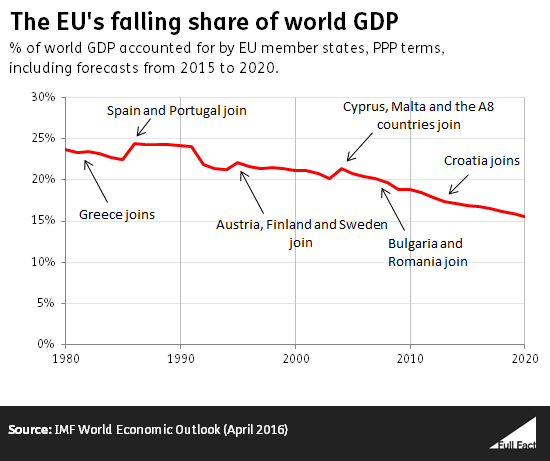
I take it from your ' If that block decreases significantly' comment that you have weighed up the historical data that clearly shows the economic decline of the eu at an alarming rate as less of a consideration in your decision making process than the possible (even taking your worst case scenarios) impact of tariffs to the uk economy.
That's one brave call FC! I would love to see the cost comparison to the UK for even the worse tariff imposition versus the impact of the declining level of economic activity in the eu -
I said this an earlier post; the models used to calculate predictions by economists are using the status quo in terms of EU output, if you had asked them to map that model with the decline in activity in the eu since 2002 - well imagine for one second the referendum was in 2002 and the calculations for future eu growth were done on the projection of what actually occurred?
Give me a graph with the worse tarrif scenario and the worse possible deal the uk can get outside the eu (I have to use 'worse' as I'm just picking up the general theme from those in the remain camp in terms of tarrifs and external trade arrangements achievable by the uk) - now that's a graph I would like to see.
Has anyone considered the option of staying in the EU and implementing illegal (or at least against EU rules) immigration controls? I am not suggesting it per se, but I wonder if it's been considered? The French seem perfectly happy to pick and choose the EU rules they want to adhere to and I am wondering if it would be so dreadful if we did the same? They could fine us of course, but (a) we could say we aren't paying and (b) might it be worth the cost anyway?
I would certainly expect that if they attempted to back track in any way on Cameron's "renegotiation".
grunge
Well-Known Member
I take it from your ' If that block decreases significantly' comment that you have weighed up the historical data that clearly shows the economic decline of the eu at an alarming rate as less of a consideration in your decision making process than the possible (even taking your worst case scenarios) impact of tariffs to the uk economy.
That's one brave call FC! I would love to see the cost comparison to the UK for even the worse tariff imposition versus the impact of the declining level of economic activity in the eu -
I said this an earlier post; the models used to calculate predictions by economists are using the status quo in terms of EU output, if you had asked them to map that model with the decline in activity in the eu since 2002 - well imagine for one second the referendum was in 2002 and the calculations for future eu growth were done on the projection of what actually occurred?
Give me a graph with the worse tarrif scenario and the worse possible deal the uk can get outside the eu (I have to use 'worse' as I'm just picking up the general theme from those in the remain camp in terms of tarrifs and external trade arrangements achievable by the uk) - now that's a graph I would like to see.
Is this decline due to any issues with the EU or the meteoric rise of china?

Chippy_boy
Well-Known Member
I take it from your ' If that block decreases significantly' comment that you have weighed up the historical data that clearly shows the economic decline of the eu at an alarming rate as less of a consideration in your decision making process than the possible (even taking your worst case scenarios) impact of tariffs to the uk economy.
That's one brave call FC! I would love to see the cost comparison to the UK for even the worse tariff imposition versus the impact of the declining level of economic activity in the eu -
I said this an earlier post; the models used to calculate predictions by economists are using the status quo in terms of EU output, if you had asked them to map that model with the decline in activity in the eu since 2002 - well imagine for one second the referendum was in 2002 and the calculations for future eu growth were done on the projection of what actually occurred?
Give me a graph with the worse tarrif scenario and the worse possible deal the uk can get outside the eu (I have to use 'worse' as I'm just picking up the general theme from those in the remain camp in terms of tarrifs and external trade arrangements achievable by the uk) - now that's a graph I would like to see.
The EU consists of a group of either fairly well advanced, or extremely well advanced countries. Growth rates in these sorts of countries - wherever they are in the world - are ALWAYS much lower than in developing countries (er, obviously). Therefore it is also equally obvious that if you have very large, developing countries such as India and China growing at near double-digits rates for decades, then *necessarily* the GDP of the developed countries falls as a proportion of the global total GDP. This is not rocket science, it is natural and completely understandable. It has *nothing* to do with the "underperformance" of the EU. The same can be said for America, Australia, Canada, Japan and all the others. All of them have had GDP's that have fallen as a percentage of the global total over this period.
In short, your graph means nothing at best, and is highly misleading at worst.
Chippy_boy
Well-Known Member
Is this decline due to any issues with the EU or the meteoric rise of china?
You beat me to it.
FanchesterCity
Well-Known Member
I take it from your ' If that block decreases significantly' comment that you have weighed up the historical data that clearly shows the economic decline of the eu at an alarming rate as less of a consideration in your decision making process than the possible (even taking your worst case scenarios) impact of tariffs to the uk economy.
That's one brave call FC! I would love to see the cost comparison to the UK for even the worse tariff imposition versus the impact of the declining level of economic activity in the eu -
I said this an earlier post; the models used to calculate predictions by economists are using the status quo in terms of EU output, if you had asked them to map that model with the decline in activity in the eu since 2002 - well imagine for one second the referendum was in 2002 and the calculations for future eu growth were done on the projection of what actually occurred?
Give me a graph with the worse tarrif scenario and the worse possible deal the uk can get outside the eu (I have to use 'worse' as I'm just picking up the general theme from those in the remain camp in terms of tarrifs and external trade arrangements achievable by the uk) - now that's a graph I would like to see.
Nope that's not what I said or meant.
My view was the tariffs are only really a consideration whilst the EU remains one big block (and thus able to impose those tariffs).
If the EU block decreases significantly is referring to the number of member in that block dramatically reducing (i.e. leaving) - by which I'm am suggesting the entire EU picture has already changed at that point and we're not dealing with one big block any more (as clearly many have already left) in reality, it's hard to see how the EU could even remain viable in such a state.
Given that situation - the EU is dramatically reduced (cos most have left) or it's disbanded altogether, then the tariffs are a moot point, and we'd be negotiating directly with all the members who'd left.
It only holds sway (for good or evil) whilst it acts as one block - without that, it's every nation for themselves.
Then if it's every nation for themselves, it's a different set of circumstances and I believe we'd be very strong (amongst the former EU members) but overall, I also think we would ALL lose out, because of the sheer turmoil across all of Europe. We'd be one of the fittest survivors if you will!
AlgarveBlu
Well-Known Member
- Joined
- 21 Aug 2005
- Messages
- 3,935
Is this decline due to any issues with the EU or the meteoric rise of china?
That makes the decline in eu activity even more puzzling surely logic would tell you that there should be some correlation in the increase in Chinese activity and growth with an increase in European activity?
In answer to your question, it is wholly down to the austerity measures implemented by the eu
( read Germany) since 2010. Countries have had to internally devalue ( they have no currency to devalue) by taking wage cuts, jobs have been decimated, less public spending, banks restructuring their capital buffers in the eu and restricting lending for investments, bail outs and that's because they do not have the ability to treat individual errors separately because of the currency.
Gelsons Dad
Well-Known Member
Correct and the ECB is continuing it's QE to feed the rot.That makes the decline in eu activity even more puzzling surely logic would tell you that there should be some correlation in the increase in Chinese activity and growth with an increase in European activity?
In answer to your question, it is wholly down to the austerity measures implemented by the eu
( read Germany) since 2010. Countries have had to internally devalue ( they have no currency to devalue) by taking wage cuts, jobs have been decimated, less public spending, banks restructuring their capital buffers in the eu and restricting lending for investments, bail outs and that's because they do not have the ability to treat individual errors separately because of the currency.
FanchesterCity
Well-Known Member
The EU consists of a group of either fairly well advanced, or extremely well advanced countries. Growth rates in these sorts of countries - wherever they are in the world - are ALWAYS much lower than in developing countries (er, obviously). Therefore it is also equally obvious that if you have very large, developing countries such as India and China growing at near double-digits rates for decades, then *necessarily* the GDP of the developed countries falls as a proportion of the global total GDP. This is not rocket science, it is natural and completely understandable. It has *nothing* to do with the "underperformance" of the EU. The same can be said for America, Australia, Canada, Japan and all the others. All of them have had GDP's that have fallen as a percentage of the global total over this period.
In short, your graph means nothing at best, and is highly misleading at worst.
Diminishing returns for the best performers, whilst those who aren't doing well, have much scope for improvement. I liken it to trying to squeeze an extra second out of a McLaren - it's hard, but you can get another second out of a pushbike. The pushbike 'improved' more, it 'grew more', but it didn't really 'perform' better.
Chippy_boy
Well-Known Member
You're not listening Algarve.That makes the decline in eu activity even more puzzling surely logic would tell you that there should be some correlation in the increase in Chinese activity and growth with an increase in European activity?
In answer to your question, it is wholly down to the austerity measures implemented by the eu
( read Germany) since 2010. Countries have had to internally devalue ( they have no currency to devalue) by taking wage cuts, jobs have been decimated, less public spending, banks restructuring their capital buffers in the eu and restricting lending for investments, bail outs and that's because they do not have the ability to treat individual errors separately because of the currency.
In the period 2005 to 2010, Brazil's GDP more than quadrupled. China has gone up by a factor of more than 10 in the last 10 years. India by so much more than 10x that I they didn't even figure in 2005.
Developed countries like those in the EU are *never* going to grow at these rates and therefore *necessarily* EU GDP will fall as a % of the world total. You're drawing completely the wrong conclusions.
If we stay in we will be shafted ! All the hype about the economy! Think on this the better we do the more we have to pay zegermans are not going to stop trading with us and nather are the french and the Spanish are not going to stop us going on holidays or any other country come to that so we pay a little more ! But we will have the choice to or not to and we won't have to pay for the privilege. If u are going to Spain this yr u will know u will have to pay for the number of days u are thare .
- Status
- Not open for further replies.