
EU referendum

EU referendum

  • In

    Votes: 503 47.9%
  • Out

    Votes: 547 52.1%

  • Total voters
    1,050
Status
Not open for further replies.
The Eurozone /EU will weaken I don't think there is any 'could' about it - if there is a leave vote then we should expect to see a crisis management team in place to firstly ensure that no other nation can start sounding out having their own referendum. Price of gold/the USD and CHF/treasuries and triple A government bonds will all go up - I'm not sure the UK would be deemed to be a safe haven for a few years until the dust settles.
Bank of England are reporting on Thursday. Expect a warning on the pound, the current account deficit, and interest rates.
 
Tariffs may be low , but they are still there, and as non-members we would have to pay them.
If trade between the EU and major non-members is booming then why would we want to leave an organisation ,of which we are members ,in order to trade with the very same non-members with which the EU are so successfully trading ? Only after leaving , we would instead be in competition with the EU for the very same trade which we already have as members of the EU.
Not Exactly true by the way!
Under International law all Treaties will stay in place until one is negotiated to replace them so we could be outside and still have the low tariffs for years to come.
Scare tactics only work because some people are too stupid or gullible to question them
 
Today's end of day headline from the Australian financial review - Brexit fears wipe 30 billion dollars from the ASX .

Are these drops that you have already had from the pound dropping and the market going or is this what awaits you today. It shows you how tiny the saving is though from Brexit that twice the annual saving that everyone is so proud of can be wiped out in one day in a far away market that only trades partially with the EU. If proportionally the same happens in Europe then the spooking will be real loss of wealth to anyone with shares with pension with investments - that may shift a few votes if the market starts to move, until recently the market assumed stability

Having read all your posts within this thread one question springs to mind.
As you are clearly the strongest advocate or the remain camp what part of the UK do you live in? I have not heard or seen anyone in the North of England any where near as Pro Remain as you
 
I've voted out. All the comments I see from people are saying "leave", however I still think Remain will just win it, sadly.
 
The stock market falls when there is a prospect of a Labour government. Maybe we should have a one-party state to avoid such events.

You could spin that to say the Stock market fell at the thought of another 5 years of the Tories, but its just spin.

Thing is, stock markets always fall a few weeks before an election so I guess this fall is no different.
 
Cameron, Osborne and their cohorts will be furiously filling in postal ballots as we speak.

Yeah I agree. Like I say all the comments on the readers sections are 90% saying "out", but I wouldn't trust this government one bit. They have already cheated by extending the voting period.
 
  1. I have a lot of respect for Daniel Hannon MEP so when he writes a warning then I tend to read it. Here he states that the EU are postponing ten issues until after we have had our referendum. No guesses for why.


    1. Banning hair-dryers

    The EU plans to outlaw high-energy dishwashers, hair-dryers and other household appliances. It comes after lobbying by German manufacturers, who see an opportunity to keep competitors out of the market.

    Even supporters reluctantly admit its environmental impact would be tiny: these gadgets account for 12 per cent of household energy use, or 1 per cent of our carbon footprint. As so often, something presented as eco-friendly turns out to be about commercial advantage.

    The proposal, as Commissioner Jyrki Katainen observes, has been ‘ridiculed in the media’. He means the British media, and he’s right. The Finnish politician’s response? Postpone it until autumn.


    2. A bigger budget

    A mid-term review of the European Union’s seven-year budget was due at the start of the year. But it’s been postponed till after our referendum. Brussels officials privately admitted they were reluctant to give extra ammunition to British Leave campaigners.

    What extra ammunition? By the EU’s own admission, its unpaid bills amount to €24.7 billion (£19.6 billion).

    Britain pays 12.5 per cent of the budget, so our share of those bills is an additional £2.4 billion. That’s before the extra money being demanded by MEPs to deal with the migration crisis.


    3. Open borders

    David Cameron tried and failed to get an agreement that the EU’s free movement rules would not apply to countries that might join the EU in future, such as Albania, Serbia, Macedonia, Montenegro and Turkey.

    If we vote to remain on unchanged terms, we are accepting in perpetuity that there can be no control over migratory flows. Having failed to get a better deal before voting to leave, there is no chance of getting one if we were to stay.

    The migration crisis has cruelly exposed the weakness of the EU’s Schengen Agreement (which abolished EU internal borders). When Britain joined, we agreed to open our borders to the EU. The EU has now clearly opened its

    borders to the world. That was never the deal.


    4. More bail-outs

    The Prime Minister has said very clearly that Britain is exempt from any further bail-outs. The trouble is, he said it in 2013. In June 2015, when Brussels needed more cash for the third Greek bail-out, the UK was forced to loan it £600 million.

    Mr Cameron hadn’t lied. He had, indeed, secured an agreement — a written agreement, drawn up in the clearest possible language — that Britain would not have to prop up a currency it had declined to join. But the moment that agreement became inconvenient, the EU ripped it up; Britain was powerless to stop it.

    How long before the euro crisis spreads to Italy and France, making Greece look like a sideshow? Jim Mellon, the investment guru, says: ‘When this happens — and I am guessing that it will within three years — the crisis will be so huge that Germany and Britain (if we are still in) would have to help out.’

    Having made a billion pounds out of knowing when to buy and sell, he is urging us to sell EU membership urgently.

    In June 2015, when Brussels needed more cash for the third Greek bail-out, the UK was forced to loan it £600 million


    5. Deeper integration

    The EU is responding to the euro and migration crises in the way it responds to everything: by giving more power to Brussels.

    To anyone else, it might seem odd to prescribe more of the medicine that sickened the patient in the first place, but Eurocrats are Eurocrats.

    In an official document last summer known as the Five Presidents’ Report (the EU has a lot of presidents), Brussels officials called for the harmonisation of budgets, economic policy and taxation, as well as elements of social security.

    Although these things are a response to the euro crisis, most will be brought in as single market measures, because that is the only legal mechanism at the EU’s disposal. They will therefore apply to all 28 member states. Britain, despite staying out of the euro and the border-free zone, will be dragged in.


    6. Human rights

    The European Court of Justice (ECJ) began life as, in effect, the highest tribunal of a trade bloc. Yet, as the EU extended its powers into new areas, the ECJ is now more like a supreme court.

    The greatest extension of its powers has come with the adoption of the EU’s Charter of Fundamental Rights and Freedoms. Suddenly, as well as economic issues, euro-judges settle human rights questions.

    For example, in a preliminary decision, they have ruled against the deportation of hate-preacher Abu Hamza’s daughter-in-law after her criminal conviction. She is not a British national, but her son is, and the ECJ holds that her deportation would violate his rights as an EU citizen.


    7. Arts import licences

    London is the centre of the global trade in fine arts, bringing in billions in revenue. Its competitors are New York, Geneva and Hong Kong.

    Britain has already been disadvantaged by the EU’s application of VAT to fine arts sales and, even more, by the preposterous Resale Rights rule, which obliges traders to pay a percentage to the heirs of the original artist each time a work is sold on.

    Now, Brussels plans an import licensing regime, which would again subject London to more cost and bureaucracy than overseas rivals.

    Anthony Browne, chairman of the British Art Market Federation, says: ‘Our big concern is that an import licence system would impose a new and very damaging burden on the British art market which is heavily dependent on cross-border trading.’


    8. Wrecking our ports

    The EU wants to oblige every port to have more than one provider for its internal services, such as mooring, dredging and unloading.

    This might make sense for state-owned or state-subsidised mega-ports on the Continent, such as Antwerp, Hamburg and Rotterdam. But it makes no sense for British ports which are private, small, and in competition with each other.

    Everyone agrees that the measure will deter investment. Every British port operator and every trade union opposes it.

    Every British MEP, from the Greens to Ukip, voted against it. But it went through the European Parliament anyway, only to have the final decision suddenly deferred.

    It, too, will come back after the referendum. If we vote to stay in, these new rules will hit some of our most successful ports, including Belfast, Glasgow, Bristol, Liverpool, Cardiff, Harwich and Southampton.


    9. Quotas for online TV

    The European Commission wants online providers to reserve 20 per cent of their content for European programmes which should, it says, be given ‘good visibility’.

    EU rules already oblige terrestrial TV to invest in, and broadcast, a certain

    amount of European material.

    The European Commission doesn’t want online providers to be exempt. So, more Euro-noir, less U.S. drama.


    10. A European Army

    ‘No one is talking about a European Army’, say Remainers. No one, except the people running the EU. The European Commission, in its formal statement, calls a European Army ‘a strategic necessity’.

    One by one, the EU has acquired the attributes of statehood: a president and a parliament; a currency and taxes; embassies and a foreign minister; a supreme court and a legal system; a national anthem and a flag. A European Army is the logical next step.
 
Not Exactly true by the way!
Under International law all Treaties will stay in place until one is negotiated to replace them so we could be outside and still have the low tariffs for years to come.
Scare tactics only work because some people are too stupid or gullible to question them
Or because they are true...... Most of the scare stories you are met with in life are scare stories based on a reality and for your own good. Those who deliberately ignore them inevitably end up losing
 
Massive assumption there mate, the negotiations haven't started yet!
It is the resultant negotiations I am worried about. Thanks for picking up on that. We will have little power. We currently have Hugh respect, and they want our products skills arts. But the likes of France will be only too happy to swing things their way from WITHIN
 
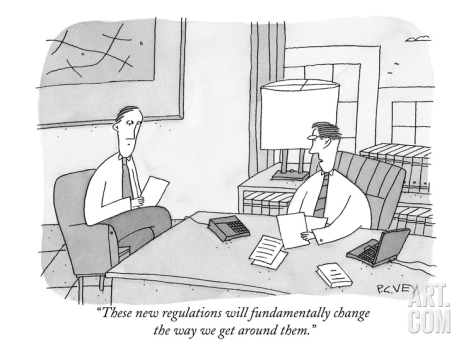
peter-c-vey-these-new-regulations-will-fundamentally-change-the-way-we-get-around-thee280a6-new-yorker-cartoon_i-g-65-6596-ido2100z.jpg
 
FTSE down 1.3% on Brexit fears that must be about ten years of the Brexit saving wiped out today so far?
Get real please, the FTSE fluctuates and has fluctuated every day since Adam was knee high to a grasshopper. You are begining to sound a little desparate. The fluctuation today may well be down to Brexit, who can prove it, if it is, it is a relatively small fluctuation.

Please keep it real. Probably Bang on average over the last three years and well up on five years, but like I say, this proves nothing.

BTW, did you enjoy the game on Saturday? I don't expect you went to today's mauling!
 
Get real please, the FTSE fluctuates and has fluctuated every day since Adam was knee high to a grasshopper. You are begining to sound a little desparate. The fluctuation today may well be down to Brexit, who can prove it, if it is, it is a relatively small fluctuation.

Please keep it real.

BTW, did you enjoy the game on Saturday? I don't expect you went to today's mauling!
You've already made clear long ago that neither scare stories or indeed facts matter remotely to you and whatever happens you are out and proud. I sincerely hope the price your kids and their kids pay is worth it.... But that won't matter because it's all a scare story and everyone will be fine and dandy . You may be loaded, but 1% of savings means a fair bit to some people
 
Or because they are true...... Most of the scare stories you are met with in life are scare stories based on a reality and for your own good. Those who deliberately ignore them inevitably end up losing
Not in the least bit true. Most of the scare stories we encounter in life are during our younger formative years, and are mostly used as a method of control. I'm sure there isn't any evidence to suggest that people subjected to scare stories thrive better than others. In later years we should really be able to make our own judgement as to whether a story has some substance, or is simply a load of bollocks.
 
  1. I have a lot of respect for Daniel Hannon MEP so when he writes a warning then I tend to read it. Here he states that the EU are postponing ten issues until after we have had our referendum. No guesses for why.


    1. Banning hair-dryers

    The EU plans to outlaw high-energy dishwashers, hair-dryers and other household appliances. It comes after lobbying by German manufacturers, who see an opportunity to keep competitors out of the market.

    Even supporters reluctantly admit its environmental impact would be tiny: these gadgets account for 12 per cent of household energy use, or 1 per cent of our carbon footprint. As so often, something presented as eco-friendly turns out to be about commercial advantage.

    The proposal, as Commissioner Jyrki Katainen observes, has been ‘ridiculed in the media’. He means the British media, and he’s right. The Finnish politician’s response? Postpone it until autumn.


    2. A bigger budget

    A mid-term review of the European Union’s seven-year budget was due at the start of the year. But it’s been postponed till after our referendum. Brussels officials privately admitted they were reluctant to give extra ammunition to British Leave campaigners.

    What extra ammunition? By the EU’s own admission, its unpaid bills amount to €24.7 billion (£19.6 billion).

    Britain pays 12.5 per cent of the budget, so our share of those bills is an additional £2.4 billion. That’s before the extra money being demanded by MEPs to deal with the migration crisis.


    3. Open borders

    David Cameron tried and failed to get an agreement that the EU’s free movement rules would not apply to countries that might join the EU in future, such as Albania, Serbia, Macedonia, Montenegro and Turkey.

    If we vote to remain on unchanged terms, we are accepting in perpetuity that there can be no control over migratory flows. Having failed to get a better deal before voting to leave, there is no chance of getting one if we were to stay.

    The migration crisis has cruelly exposed the weakness of the EU’s Schengen Agreement (which abolished EU internal borders). When Britain joined, we agreed to open our borders to the EU. The EU has now clearly opened its

    borders to the world. That was never the deal.


    4. More bail-outs

    The Prime Minister has said very clearly that Britain is exempt from any further bail-outs. The trouble is, he said it in 2013. In June 2015, when Brussels needed more cash for the third Greek bail-out, the UK was forced to loan it £600 million.

    Mr Cameron hadn’t lied. He had, indeed, secured an agreement — a written agreement, drawn up in the clearest possible language — that Britain would not have to prop up a currency it had declined to join. But the moment that agreement became inconvenient, the EU ripped it up; Britain was powerless to stop it.

    How long before the euro crisis spreads to Italy and France, making Greece look like a sideshow? Jim Mellon, the investment guru, says: ‘When this happens — and I am guessing that it will within three years — the crisis will be so huge that Germany and Britain (if we are still in) would have to help out.’

    Having made a billion pounds out of knowing when to buy and sell, he is urging us to sell EU membership urgently.

    In June 2015, when Brussels needed more cash for the third Greek bail-out, the UK was forced to loan it £600 million


    5. Deeper integration

    The EU is responding to the euro and migration crises in the way it responds to everything: by giving more power to Brussels.

    To anyone else, it might seem odd to prescribe more of the medicine that sickened the patient in the first place, but Eurocrats are Eurocrats.

    In an official document last summer known as the Five Presidents’ Report (the EU has a lot of presidents), Brussels officials called for the harmonisation of budgets, economic policy and taxation, as well as elements of social security.

    Although these things are a response to the euro crisis, most will be brought in as single market measures, because that is the only legal mechanism at the EU’s disposal. They will therefore apply to all 28 member states. Britain, despite staying out of the euro and the border-free zone, will be dragged in.


    6. Human rights

    The European Court of Justice (ECJ) began life as, in effect, the highest tribunal of a trade bloc. Yet, as the EU extended its powers into new areas, the ECJ is now more like a supreme court.

    The greatest extension of its powers has come with the adoption of the EU’s Charter of Fundamental Rights and Freedoms. Suddenly, as well as economic issues, euro-judges settle human rights questions.

    For example, in a preliminary decision, they have ruled against the deportation of hate-preacher Abu Hamza’s daughter-in-law after her criminal conviction. She is not a British national, but her son is, and the ECJ holds that her deportation would violate his rights as an EU citizen.


    7. Arts import licences

    London is the centre of the global trade in fine arts, bringing in billions in revenue. Its competitors are New York, Geneva and Hong Kong.

    Britain has already been disadvantaged by the EU’s application of VAT to fine arts sales and, even more, by the preposterous Resale Rights rule, which obliges traders to pay a percentage to the heirs of the original artist each time a work is sold on.

    Now, Brussels plans an import licensing regime, which would again subject London to more cost and bureaucracy than overseas rivals.

    Anthony Browne, chairman of the British Art Market Federation, says: ‘Our big concern is that an import licence system would impose a new and very damaging burden on the British art market which is heavily dependent on cross-border trading.’


    8. Wrecking our ports

    The EU wants to oblige every port to have more than one provider for its internal services, such as mooring, dredging and unloading.

    This might make sense for state-owned or state-subsidised mega-ports on the Continent, such as Antwerp, Hamburg and Rotterdam. But it makes no sense for British ports which are private, small, and in competition with each other.

    Everyone agrees that the measure will deter investment. Every British port operator and every trade union opposes it.

    Every British MEP, from the Greens to Ukip, voted against it. But it went through the European Parliament anyway, only to have the final decision suddenly deferred.

    It, too, will come back after the referendum. If we vote to stay in, these new rules will hit some of our most successful ports, including Belfast, Glasgow, Bristol, Liverpool, Cardiff, Harwich and Southampton.


    9. Quotas for online TV

    The European Commission wants online providers to reserve 20 per cent of their content for European programmes which should, it says, be given ‘good visibility’.

    EU rules already oblige terrestrial TV to invest in, and broadcast, a certain

    amount of European material.

    The European Commission doesn’t want online providers to be exempt. So, more Euro-noir, less U.S. drama.


    10. A European Army

    ‘No one is talking about a European Army’, say Remainers. No one, except the people running the EU. The European Commission, in its formal statement, calls a European Army ‘a strategic necessity’.

    One by one, the EU has acquired the attributes of statehood: a president and a parliament; a currency and taxes; embassies and a foreign minister; a supreme court and a legal system; a national anthem and a flag. A European Army is the logical next step.


A Brexiter by any chance ?! You've only got to look at his photo and the words right wing twat spring to mind !
 
Status
Not open for further replies.

Don't have an account? Register now and see fewer ads!

SIGN UP
Back
Top