
Exciting deep dive on the young player by Michael Caley, a football data analyst and one of the figures responsible for the development and popularisation of the expected goals stat (xG). Article source: https://www.expectinggoals.com/p/is-this-the-first-american-soccer
we have numbers, and they are good
Cavan Sullivan has been the next great American hope for a while. When Sullivan was just 14 years old, his MLS club, the Philadelphia Union, agreed with Manchester City on transfer terms to send him to the Premier League when he turns 18. Then he became the youngest-ever player in MLS when he debuted at age 14 in 2024. This season for the Union, Sullivan spent most of the spring as a rotation player, with six starts out of 13 appearances for about 650 minutes. His contributions were good, especially for a 16-year-old, but unspectacular. The potential was obvious, but it remained potential, a story about how well-regarded he was in the game.
Over the World Cup summer break, this story changed. Sullivan was added to the Union’s starting XI on July 23 and has started every match since. He has been one of the best players in MLS since joining the lineup, with five goals and four assists in a little under 900 minutes. Now these performances have earned Sullivan his first call-up to the United States Men’s National Team for a set of friendlies during the upcoming international break.
It is always exciting for fans when a hyped prospect starts to deliver on his potential. And it is even more exciting for statistical analysts who write newsletters when a player finally gets enough minutes in a senior league to develop an objective statistical profile.
And it’s a good profile.
Sullivan has now played over 1,500 minutes for the Philadelphia Union, and what stands out immediately in his numbers is that he does everything well. In my xG system he is averaging nearly 0.7 expected goals plus expected goals assisted per 90 minutes, split about evenly between xG and xG assisted. He is averaging a little under three shots attempted and two shots assisted per 90. And he is also carrying a heavy ball progression load for the Union, averaging nearly five progressive passes and four progressive carries per 90 as well. Each of these numbers individually stands in the top 10 to top 30 in MLS this season among attackers, but very few players have managed to contribute in so many ways at once.
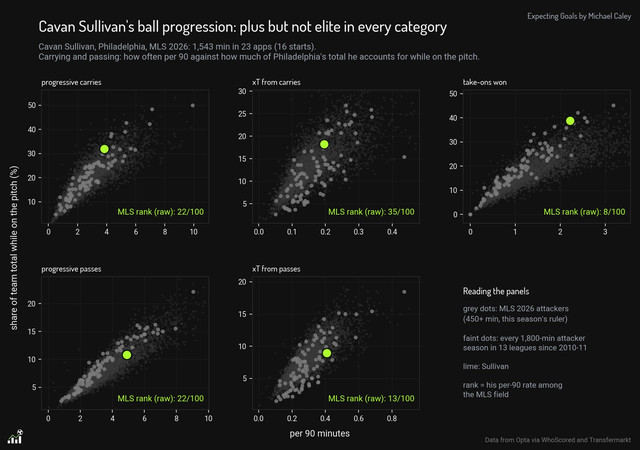
Sullivan’s take-ons are his clearest standout statistic, but demonstrating roughly equal skills moving the ball forward by carry or by pass stands out. And that’s without getting into the goals and the shot creation.

Once again, he is filling up the box score, getting good shots for himself, finishing them at a reasonable rate, and creating for his teammates.
Sullivan’s numbers also raise one point about how the Expecting Goals “Remember Some Guys” Comps System works. The charts above show Sullivan’s numbers on scatter plots. The x-axis (how far to your right the dot is) shows his raw production. The y-axis (the height of the dot) shows his production as a share of his team’s production while on the pitch. The comps system uses a blend of raw and team share, to capture how player production in soccer is a function of both the player’s own abilities and the quality of their teammates and tendencies of the tactical system in which they play. For Sullivan, his Philadelphia Union teammates have been putting up elite passing and xG numbers while he’s been on the pitch. So in the “team share” portion, his end product and passing progression are downgraded. But he is the only player on the Union doing lots of ball-carrying, which in turn bumps up his ratings on that metric. Opposition defenses should know to key on Sullivan as the team’s top ball-carrier and 1v1 attacker, and he still puts up numbers.

Sullivan’s xG per 90 is 19th among MLS attackers but his xG share is just 57th. That is the most extreme case, but in general, the Union have not depended particularly on Sullivan to finish their chances. What the team share adjustment does is take an already-balanced statistical profile and make it even more balanced by scaling up the ball carrying and slightly scaling down the passing and end product.
In broad strokes, this is a recognizable kind of player. I ran the comps system for every league I have coded in and found a large number of similar seasons. Obviously these player-seasons are comparable to one another only in relation to their leagues. A player who can put up the same numbers against Premier League opposition has done something more impressive than someone putting up that record in the Eredivisie. But as a type of player, this captures what Sullivan has shown.
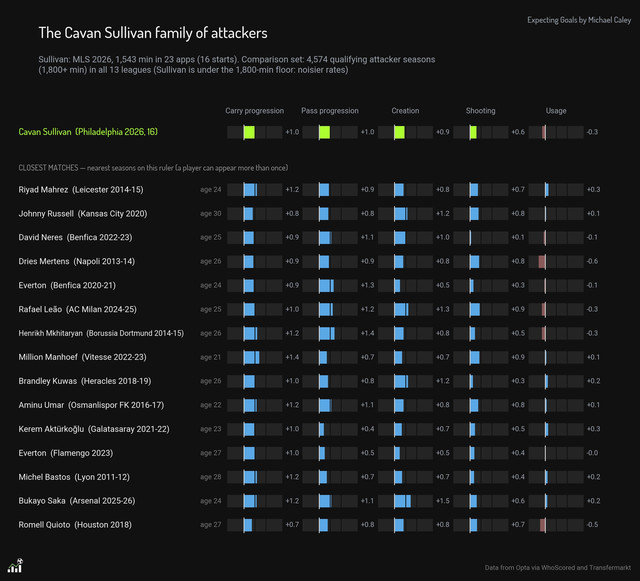
For fans of top-level European soccer, the type here is exemplified by Riyad Mahrez, Dries Mertens and Henrikh Mkhitaryan. These are players who played off the wing, but tended to come inside and often attacked more from the 10 space than the wing. Sullivan, despite playing on the wing, has only about 57 percent of his touches in wide areas. Pure wingers tend to be at 75 percent, and inverted wingers in the 60s. This balanced positional profile then tends to go along with a balanced statistical profile, mixing passing and carries and shot production.1
For fans of MLS, Johnny Russell of Sporting KC offers one of the best comps—Russell has two other seasons in the top 50 for Sullivan as well. He was another wide attacker who didn’t have the pure pace of a traditional winger, but depended on a varied mix of skills and an ability to play in the center of the pitch and the penalty area.
What this captures, I think, is that players who are above average in every aspect of attacking play are rare and valuable. They are not superstars, but they are among the top players at their positions in the league. And they typically have a similar positional profile to Sullivan, as wing-10 hybrids. They are usually not the most elite athletes but use a mix of skills to elevate their games.
This analysis raises a number of questions. We can describe Cavan Sullivan’s current player type. We can say Cavan Sullivan is putting up numbers that rate among the best in MLS. But what does that mean? He’s 16 after all. Will he become a superstar from here? The comps chart did not include anyone under the age of 21 and most of the players were in their mid-20s or later? What happens to young players who show these types of skills at a very young age?
Further, there are league and opposition quality questions. How tough is it to play against MLS defenders? How good is Major League Soccer in 2026? What would we expect to happen if Sullivan joined Manchester City in a year and a half, or what if he was loaned out to the Championship or the Eredivisie? How does MLS stack up with those leagues?
I need to start with that header because otherwise the top comps chart is an absurd headline of its own.
Yes, that’s Lamine Yamal.
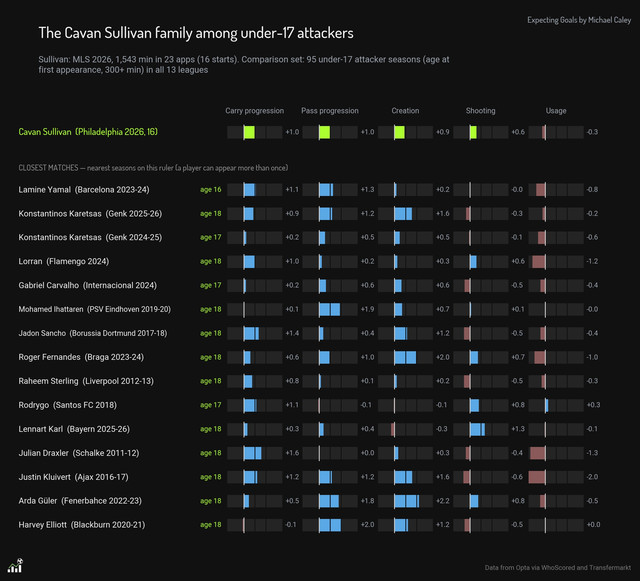
Obviously Lamine put up his numbers at 16 against La Liga defenses. But more than that, the similar scores here are all quite low. All of the player-seasons on the initial list were within 0.4 similarity distance. Here Lamine is at 0.54 similarity distance and everyone else is above 0.65.
What we see with young attackers is that they tend to have one of two profiles. Either they carry the ball at prodigious rates and get tons of shots, or they do elite ball progression and shot creation but not much of anything else. Rodrygo on the above chart represents the former category. Estêvão’s age-17 season in Brazil, which doesn’t make the list, is an extreme case. Then there are the pure passers, exemplified by Harvey Elliott and Arda Güler toward the bottom of this chart and Konstantinos Karetsas toward the top. (Note this is Elliott in the Championship with Blackburn and Güler at Fenerbahce before his move to Real Madrid.)
I created a cluster map of attackers 18 and under to demonstrate this. The blazing fast carry-and-shoot types are in yellow and the teenage maestros are in pink. (Blue is the third type of young player, the ones with relatively minimal statistical production.)
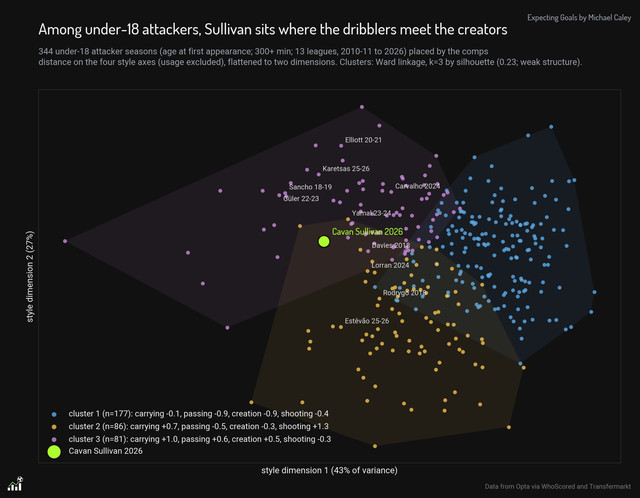
It is difficult to project Sullivan because there are already vanishingly few players who are this good at age 16, and then there are no players in the dataset who were this good at age 16, 17 or 18 and have a similar statistical profile to Sullivan.
His top comps include a few washouts, several players who are still too young to judge, but mostly players who went on to have good careers in top European leagues. And Lamine.
So this opens up the question of how to evaluate present-day MLS in relation to other leagues.
It is hard to estimate the relative quality of leagues that do not play matches against one another. I did create a model based on betting odds that incorporated the Club World Cup, and at that time it suggested that MLS was about on par with the Dutch Eredivisie and the Portuguese Primeira Liga. But the sample was very small and unrepresentative. The best data remains the valuations at Transfermarkt.com, which do happen to tell a story reasonably commensurate with the Club World Cup analysis.
In 2011, the median MLS team had a Transfermarkt valuation a little under ten percent of the median Premier League team. In 2026, the ratio is nearly identical. But that does not mean MLS has not improved. The defining story of European football in the last 15 years has been that of increasing Premier League dominance. MLS is one of the only leagues in the world that has kept pace with the PL over that time, which in turn means it has been gaining steadily on continental leagues.
At this point, the median MLS team is probably stronger than the median team in the Eredivisie or the Primeira Liga. These highly unequal leagues have top teams better than any in MLS, but the rest of the league is notably worse. More competitively balanced leagues like the English Championship, the Belgian Pro League, and the Brazilian Série A all run ahead of MLS on this account.
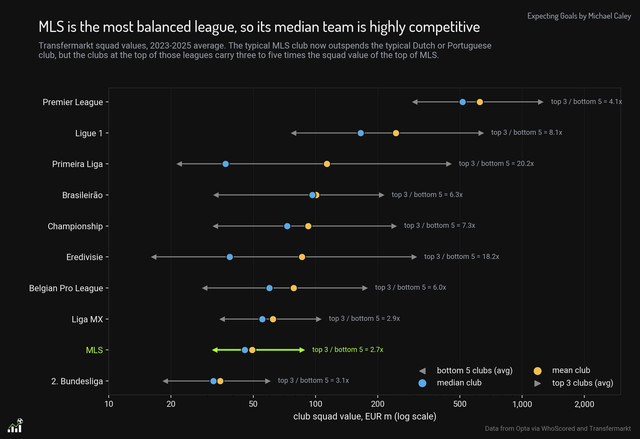
One way of putting it is that week to week, Cavan Sullivan is facing tougher opposition than a player on Benfica or PSV does. But he also never has to face a Porto or an Ajax.
A decade ago, most of these leagues were at least 20 percent ahead of MLS on median squad value, and now MLS has surpassed a number of them. Even in average value, they have clearly gained.
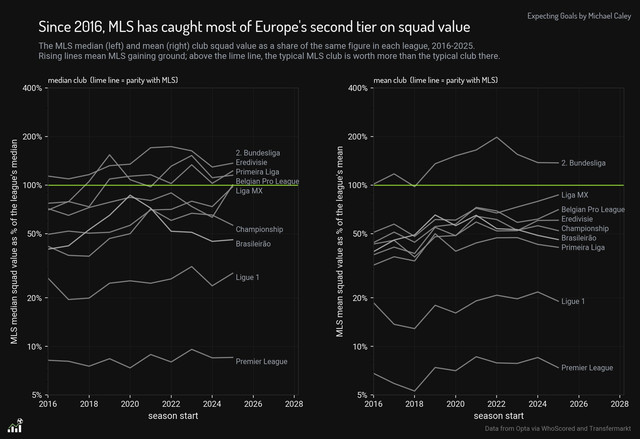
What does this mean for Cavan Sullivan? It suggests that he is generally facing opposition that is comparable to what players in many continental European leagues face, at least outside the big five of Ligue 1, Serie A, La Liga, the Bundesliga and the Premier League.
This all suggests that the comps system above is working mostly within the right universe. Most of the players on his similar players list faced reasonably similar levels of opposition strength. (Except Lamine.) Sullivan’s statistical profile is both excellent for a 16-year-old and notably unique. He compares mostly to players who have gone on to be good players, if not superstars, at some of the richest clubs in the world. But he is different enough from all of them that it is not easy to lock in on any particular path. And, of course, at 16, he is a year younger than most of the players on the list, which is disproportionately age-17 seasons. (Except Lamine.)
There is one final confounding point to add to all of this.
As I noted above, Sullivan joined the starting lineup after the MLS summer break for the World Cup. And he has not merely picked up starts, he has also been notably better in these minutes. It is under 900 minutes and no one should overreact to it, but it is possible that Sullivan is already significantly better than the baseline stats I used for this article.
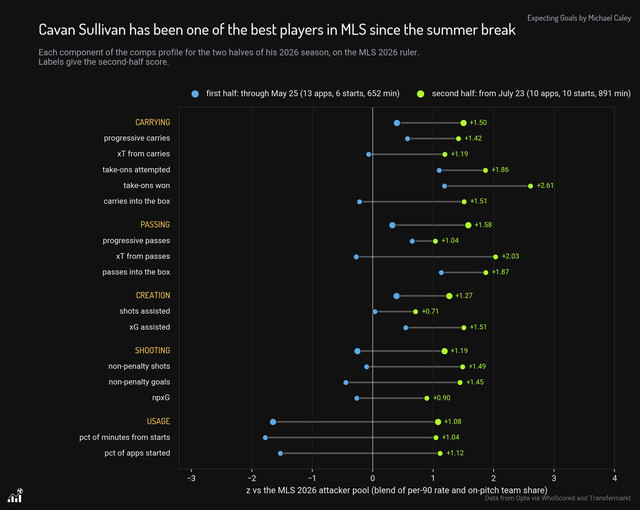
This is an across-the-board improvement on numbers that were already unusually broad for a young player. He has been a standard deviation or more above the MLS median across every axis. Sullivan’s level since the summer break is in range of player of the season quality, at least in a league without Lionel Messi.
If I run the comps for players close to Sullivan’s level, limited to just his post-break statistics, the results are pretty goofy.
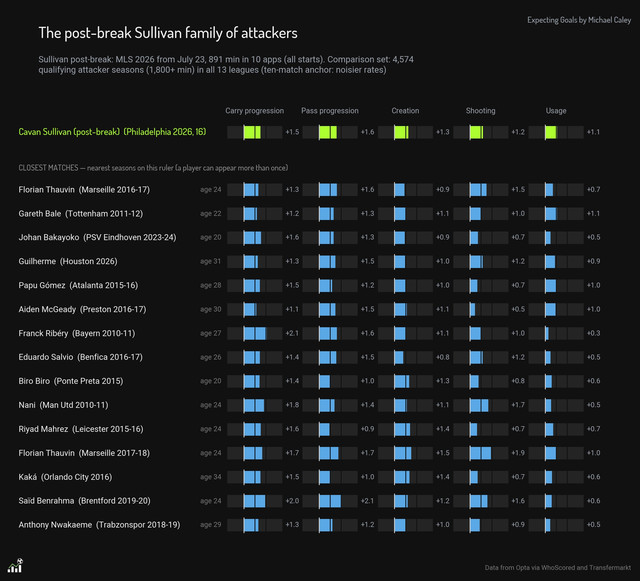
At the top level, we are looking at elite playmakers off the wing: Florian Thauvin’s Marseille peak, Papu Gómez at Atalanta, and Nani at Manchester United. Another level down there is Johan Bakayoko at PSV and Saïd Benrahma at Brentford, both dominant stars in their leagues at the time. And once again, these are mostly peak age players, none of them teenagers and certainly none of them still to be teenagers three years later.
His U17 comps board becomes utterly useless. Lamine’s 2024-25 season is the most similar at 0.77, and nobody else is within 1.0. No player 17 or under, at any level in my database, has done anything similar to what Sullivan has done for Philadelphia since the summer break. Some players, like Güler, Karetsas, Estêvão or Vinícius Jr, were similarly productive overall but none in a manner at all similar to Sullivan.
It is hard to know what to do with these results. One cannot assume that Sullivan will continue to produce at this level. The sample is only ten matches. But in those ten matches, he is performing at levels only reached by the very best prospects in world football over the last decade, and with a unique distribution of skills.
I am left mostly with questions. What does it mean that Sullivan’s skill set is so unusual among prospects? Does it suggest a lower ceiling because he has less skill development room? Or does he, at 16, have the potential to add speed and strength to his game that will allow his skills to play up even more?
Has Sullivan made yet another leap in the last few months? What would it mean for a 16-year-old to be one of the best few players in MLS? Has MLS become a strong enough league, as some broad metrics suggest, that this should project like being one of the best players in Portugal, Belgium or the Netherlands?
How much more development room does Sullivan have? Most players at 16 have no statistical profile because they are not good enough to play senior football. They make large strides in ability to earn minutes at 19, 20, 21 years old. Will Sullivan continue on that sort of development path over the next few years?
But the questions and the uncertainty should not obscure how high the baseline is. Cavan Sullivan is playing at a level that vanishingly few players achieve at 16 or 17 years old. His comparables suggest he is a very good top-level prospect, unless they show he is an elite one. He has demonstrated a degree of across-the-board skill that is even more unusual for his age than his performance level.
There is every reason for American soccer fans, and indeed even for Manchester City fans, to be excited about Cavan Sullivan based on what he has done this season in MLS.
1. There are also a couple of pure wingers here, Rafael Leao and Bukayo Saka, who have demonstrated excellent possession skill as well, but have a somewhat different positional profile. Saka, it should be noted, is also that classic comps situation where a player’s statistical profile is similar but better across the board.
Is this the first American soccer superstar? How 16-year-old Cavan Sullivan earned a USMNT call-up
we have numbers, and they are good
Cavan Sullivan has been the next great American hope for a while. When Sullivan was just 14 years old, his MLS club, the Philadelphia Union, agreed with Manchester City on transfer terms to send him to the Premier League when he turns 18. Then he became the youngest-ever player in MLS when he debuted at age 14 in 2024. This season for the Union, Sullivan spent most of the spring as a rotation player, with six starts out of 13 appearances for about 650 minutes. His contributions were good, especially for a 16-year-old, but unspectacular. The potential was obvious, but it remained potential, a story about how well-regarded he was in the game.
Over the World Cup summer break, this story changed. Sullivan was added to the Union’s starting XI on July 23 and has started every match since. He has been one of the best players in MLS since joining the lineup, with five goals and four assists in a little under 900 minutes. Now these performances have earned Sullivan his first call-up to the United States Men’s National Team for a set of friendlies during the upcoming international break.
It is always exciting for fans when a hyped prospect starts to deliver on his potential. And it is even more exciting for statistical analysts who write newsletters when a player finally gets enough minutes in a senior league to develop an objective statistical profile.
And it’s a good profile.
What kind of player is Cavan Sullivan?
Sullivan has now played over 1,500 minutes for the Philadelphia Union, and what stands out immediately in his numbers is that he does everything well. In my xG system he is averaging nearly 0.7 expected goals plus expected goals assisted per 90 minutes, split about evenly between xG and xG assisted. He is averaging a little under three shots attempted and two shots assisted per 90. And he is also carrying a heavy ball progression load for the Union, averaging nearly five progressive passes and four progressive carries per 90 as well. Each of these numbers individually stands in the top 10 to top 30 in MLS this season among attackers, but very few players have managed to contribute in so many ways at once.
Sullivan’s take-ons are his clearest standout statistic, but demonstrating roughly equal skills moving the ball forward by carry or by pass stands out. And that’s without getting into the goals and the shot creation.
Once again, he is filling up the box score, getting good shots for himself, finishing them at a reasonable rate, and creating for his teammates.
Sullivan’s numbers also raise one point about how the Expecting Goals “Remember Some Guys” Comps System works. The charts above show Sullivan’s numbers on scatter plots. The x-axis (how far to your right the dot is) shows his raw production. The y-axis (the height of the dot) shows his production as a share of his team’s production while on the pitch. The comps system uses a blend of raw and team share, to capture how player production in soccer is a function of both the player’s own abilities and the quality of their teammates and tendencies of the tactical system in which they play. For Sullivan, his Philadelphia Union teammates have been putting up elite passing and xG numbers while he’s been on the pitch. So in the “team share” portion, his end product and passing progression are downgraded. But he is the only player on the Union doing lots of ball-carrying, which in turn bumps up his ratings on that metric. Opposition defenses should know to key on Sullivan as the team’s top ball-carrier and 1v1 attacker, and he still puts up numbers.
Sullivan’s xG per 90 is 19th among MLS attackers but his xG share is just 57th. That is the most extreme case, but in general, the Union have not depended particularly on Sullivan to finish their chances. What the team share adjustment does is take an already-balanced statistical profile and make it even more balanced by scaling up the ball carrying and slightly scaling down the passing and end product.
In broad strokes, this is a recognizable kind of player. I ran the comps system for every league I have coded in and found a large number of similar seasons. Obviously these player-seasons are comparable to one another only in relation to their leagues. A player who can put up the same numbers against Premier League opposition has done something more impressive than someone putting up that record in the Eredivisie. But as a type of player, this captures what Sullivan has shown.
For fans of top-level European soccer, the type here is exemplified by Riyad Mahrez, Dries Mertens and Henrikh Mkhitaryan. These are players who played off the wing, but tended to come inside and often attacked more from the 10 space than the wing. Sullivan, despite playing on the wing, has only about 57 percent of his touches in wide areas. Pure wingers tend to be at 75 percent, and inverted wingers in the 60s. This balanced positional profile then tends to go along with a balanced statistical profile, mixing passing and carries and shot production.1
For fans of MLS, Johnny Russell of Sporting KC offers one of the best comps—Russell has two other seasons in the top 50 for Sullivan as well. He was another wide attacker who didn’t have the pure pace of a traditional winger, but depended on a varied mix of skills and an ability to play in the center of the pitch and the penalty area.
What this captures, I think, is that players who are above average in every aspect of attacking play are rare and valuable. They are not superstars, but they are among the top players at their positions in the league. And they typically have a similar positional profile to Sullivan, as wing-10 hybrids. They are usually not the most elite athletes but use a mix of skills to elevate their games.
This analysis raises a number of questions. We can describe Cavan Sullivan’s current player type. We can say Cavan Sullivan is putting up numbers that rate among the best in MLS. But what does that mean? He’s 16 after all. Will he become a superstar from here? The comps chart did not include anyone under the age of 21 and most of the players were in their mid-20s or later? What happens to young players who show these types of skills at a very young age?
Further, there are league and opposition quality questions. How tough is it to play against MLS defenders? How good is Major League Soccer in 2026? What would we expect to happen if Sullivan joined Manchester City in a year and a half, or what if he was loaned out to the Championship or the Eredivisie? How does MLS stack up with those leagues?
Cavan Sullivan is not particularly similar to any other young players
I need to start with that header because otherwise the top comps chart is an absurd headline of its own.
Yes, that’s Lamine Yamal.
Obviously Lamine put up his numbers at 16 against La Liga defenses. But more than that, the similar scores here are all quite low. All of the player-seasons on the initial list were within 0.4 similarity distance. Here Lamine is at 0.54 similarity distance and everyone else is above 0.65.
What we see with young attackers is that they tend to have one of two profiles. Either they carry the ball at prodigious rates and get tons of shots, or they do elite ball progression and shot creation but not much of anything else. Rodrygo on the above chart represents the former category. Estêvão’s age-17 season in Brazil, which doesn’t make the list, is an extreme case. Then there are the pure passers, exemplified by Harvey Elliott and Arda Güler toward the bottom of this chart and Konstantinos Karetsas toward the top. (Note this is Elliott in the Championship with Blackburn and Güler at Fenerbahce before his move to Real Madrid.)
I created a cluster map of attackers 18 and under to demonstrate this. The blazing fast carry-and-shoot types are in yellow and the teenage maestros are in pink. (Blue is the third type of young player, the ones with relatively minimal statistical production.)
It is difficult to project Sullivan because there are already vanishingly few players who are this good at age 16, and then there are no players in the dataset who were this good at age 16, 17 or 18 and have a similar statistical profile to Sullivan.
His top comps include a few washouts, several players who are still too young to judge, but mostly players who went on to have good careers in top European leagues. And Lamine.
So this opens up the question of how to evaluate present-day MLS in relation to other leagues.
MLS keeps getting better
It is hard to estimate the relative quality of leagues that do not play matches against one another. I did create a model based on betting odds that incorporated the Club World Cup, and at that time it suggested that MLS was about on par with the Dutch Eredivisie and the Portuguese Primeira Liga. But the sample was very small and unrepresentative. The best data remains the valuations at Transfermarkt.com, which do happen to tell a story reasonably commensurate with the Club World Cup analysis.
In 2011, the median MLS team had a Transfermarkt valuation a little under ten percent of the median Premier League team. In 2026, the ratio is nearly identical. But that does not mean MLS has not improved. The defining story of European football in the last 15 years has been that of increasing Premier League dominance. MLS is one of the only leagues in the world that has kept pace with the PL over that time, which in turn means it has been gaining steadily on continental leagues.
At this point, the median MLS team is probably stronger than the median team in the Eredivisie or the Primeira Liga. These highly unequal leagues have top teams better than any in MLS, but the rest of the league is notably worse. More competitively balanced leagues like the English Championship, the Belgian Pro League, and the Brazilian Série A all run ahead of MLS on this account.
One way of putting it is that week to week, Cavan Sullivan is facing tougher opposition than a player on Benfica or PSV does. But he also never has to face a Porto or an Ajax.
A decade ago, most of these leagues were at least 20 percent ahead of MLS on median squad value, and now MLS has surpassed a number of them. Even in average value, they have clearly gained.
What does this mean for Cavan Sullivan? It suggests that he is generally facing opposition that is comparable to what players in many continental European leagues face, at least outside the big five of Ligue 1, Serie A, La Liga, the Bundesliga and the Premier League.
This all suggests that the comps system above is working mostly within the right universe. Most of the players on his similar players list faced reasonably similar levels of opposition strength. (Except Lamine.) Sullivan’s statistical profile is both excellent for a 16-year-old and notably unique. He compares mostly to players who have gone on to be good players, if not superstars, at some of the richest clubs in the world. But he is different enough from all of them that it is not easy to lock in on any particular path. And, of course, at 16, he is a year younger than most of the players on the list, which is disproportionately age-17 seasons. (Except Lamine.)
There is one final confounding point to add to all of this.
Is Cavan Sullivan getting better too?
As I noted above, Sullivan joined the starting lineup after the MLS summer break for the World Cup. And he has not merely picked up starts, he has also been notably better in these minutes. It is under 900 minutes and no one should overreact to it, but it is possible that Sullivan is already significantly better than the baseline stats I used for this article.
This is an across-the-board improvement on numbers that were already unusually broad for a young player. He has been a standard deviation or more above the MLS median across every axis. Sullivan’s level since the summer break is in range of player of the season quality, at least in a league without Lionel Messi.
If I run the comps for players close to Sullivan’s level, limited to just his post-break statistics, the results are pretty goofy.
At the top level, we are looking at elite playmakers off the wing: Florian Thauvin’s Marseille peak, Papu Gómez at Atalanta, and Nani at Manchester United. Another level down there is Johan Bakayoko at PSV and Saïd Benrahma at Brentford, both dominant stars in their leagues at the time. And once again, these are mostly peak age players, none of them teenagers and certainly none of them still to be teenagers three years later.
His U17 comps board becomes utterly useless. Lamine’s 2024-25 season is the most similar at 0.77, and nobody else is within 1.0. No player 17 or under, at any level in my database, has done anything similar to what Sullivan has done for Philadelphia since the summer break. Some players, like Güler, Karetsas, Estêvão or Vinícius Jr, were similarly productive overall but none in a manner at all similar to Sullivan.
It is hard to know what to do with these results. One cannot assume that Sullivan will continue to produce at this level. The sample is only ten matches. But in those ten matches, he is performing at levels only reached by the very best prospects in world football over the last decade, and with a unique distribution of skills.
I am left mostly with questions. What does it mean that Sullivan’s skill set is so unusual among prospects? Does it suggest a lower ceiling because he has less skill development room? Or does he, at 16, have the potential to add speed and strength to his game that will allow his skills to play up even more?
Has Sullivan made yet another leap in the last few months? What would it mean for a 16-year-old to be one of the best few players in MLS? Has MLS become a strong enough league, as some broad metrics suggest, that this should project like being one of the best players in Portugal, Belgium or the Netherlands?
How much more development room does Sullivan have? Most players at 16 have no statistical profile because they are not good enough to play senior football. They make large strides in ability to earn minutes at 19, 20, 21 years old. Will Sullivan continue on that sort of development path over the next few years?
But the questions and the uncertainty should not obscure how high the baseline is. Cavan Sullivan is playing at a level that vanishingly few players achieve at 16 or 17 years old. His comparables suggest he is a very good top-level prospect, unless they show he is an elite one. He has demonstrated a degree of across-the-board skill that is even more unusual for his age than his performance level.
There is every reason for American soccer fans, and indeed even for Manchester City fans, to be excited about Cavan Sullivan based on what he has done this season in MLS.
1. There are also a couple of pure wingers here, Rafael Leao and Bukayo Saka, who have demonstrated excellent possession skill as well, but have a somewhat different positional profile. Saka, it should be noted, is also that classic comps situation where a player’s statistical profile is similar but better across the board.
Last edited: