
Student Debt

Silva Citizen

Well-Known Member
Joined
29 Nov 2013
Messages
1,004
I’ve just seen the over £45k debt that my daughter owes the nation after three years Uni and I am fuming.

They say it’s not real debt and It doesn’t affect a students ability to get loans such as mortgages - Maybe not but it sure as hell affects there ability to repay loans when the debt is being taken at source.
If this type of debt was being sold by ocean finance there sure as hell would be a mis selling scandal.

Is 18 too soon to be giving our kids decisions on debt that potentially will affect the rest of their lives ?

As an employer I can honestly say that a University degree does little to enhance a thirty somethings job prospects (Supply Chain) as there are just so many of people with degrees now. I give much more weight to experience and social awareness than I do qualification's, so is there value in degrees ?

How many people who went to university instead of real work (4 years approx £60k debt) against 4 years of earning say 25k a year =£100k reckon that their degree has bridges the 160k plus interest gap ?
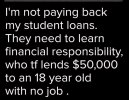
 
The problem is as the debt has increased, the value of the qualification has gone down. It used to be a no-brainer. You get into a bit of debt, but your earnings potential over your lifetime easily makes up for it. Nowadays, it's a far more of a gamble. And then they wonder why no-one can afford a house and no-one is having kids when they get an additional 9% tax on all of their earnings from the age of 21.

And it's not even about the choice of degree either, because the more potentially lucrative degrees like law, finance or computer science are so oversubscribed in relation to the number of jobs in those fields. Most law graduates are never becoming a lawyer by a huge margin.
 
I suppose the simple solution is either not go to university or do a course in university that will pay for itself when you graduate.
Easier said than done. You kinda have to predict not only what will be useful, but what will have enough opportunities to hire all of the people who've had the same idea as you. You even hear about medical graduates struggling to find junior doctor roles these days.
 
I suppose the simple solution is either not go to university or do a course in university that will pay for itself when you graduate.

A lot of student debt isn't paid back anyway is it?
That’s exactly how it’s sold to them, but the fact remains if they earn they pay, That money is taken at source (Paye) so it affects ability to pay this months mortgage or whatever. Also if some don’t pay it fully back for any reason how is that failing those that do ?
 
Easier said than done. You kinda have to predict not only what will be useful, but what will have enough opportunities to hire all of the people who've had the same idea as you. You even hear about medical graduates struggling to find junior doctor roles these days.


The more people there are going to university the more common it is for people to have degrees, in the 60's 4% of people went to University, in the 70's it was 13% and now it's 39%.

If you can't make a degree profitable then you can't expect to earn money from it.
 
I suppose the simple solution is either not go to university or do a course in university that will pay for itself when you graduate.

A lot of student debt isn't paid back anyway is it?
The reason that some of debt is not paid back is because they never earn enough money despite the supposed financial "advantages" that going to university brings. Interestingly when fees for university were introduced the majority of the people that voted for it were graduates who had benefitted from a free university education (and in many cases had received grants to help them through university) The massive expasion in university places and the ridiculous aim of a 'degree educated' population was utter bollocks. Both my sons went to university, left saddled with debt and neither of them would have got there in the 1970's because they wouldn't have passed the exams needed to get there. There has been a continuous dumbing down of education standards for decades now and it really makes me angry. When I was still working I worked with numerous graduates who couldn't spell, had appalling grammar, no idea of history or geography because it isn't taught any more. Being able to take a calculator to a maths exam says it all doesn't it?
 
The reason that some of debt is not paid back is because they never earn enough money despite the supposed financial "advantages" that going to university brings. Interestingly when fees for university were introduced the majority of the people that voted for it were graduates who had benefitted from a free university education (and in many cases had received grants to help them through university) The massive expasion in university places and the ridiculous aim of a 'degree educated' population was utter bollocks. Both my sons went to university, left saddled with debt and neither of them would have got there in the 1970's because they wouldn't have passed the exams needed to get there. There has been a continuous dumbing down of education standards for decades now and it really makes me angry. When I was still working I worked with numerous graduates who couldn't spell, had appalling grammar, no idea of history or geography because it isn't taught any more. Being able to take a calculator to a maths exam says it all doesn't it?

Universities are big business now mate, your post make a shed load of sense and surely the many victims who attend the hallowed halls can see it for themselves too.
 
The more people there are going to university the more common it is for people to have degrees, in the 60's 4% of people went to University, in the 70's it was 13% and now it's 39%.

If you can't make a degree profitable then you can't expect to earn money from it.
This is the elephant in the room, and I say that as someone who did an arty-farty waste of time first degree - fortunately for me in the days before tuition fees.
The increase in university education you describe has in a lot of (not all) cases been in inverse proportion to a corresponding decrease in academic rigour. Overall the whole scheme is a way to mask youth unemployment since the death of manufacturing and successive governments of all hues are complicit.
 
Last edited:
This is the elephant in the room, and I say that as someone who did an arty-farty water of time first degree - fortunately for me in the days before tuition fees.
The increase in university education you describe has in a lot of (not all) cases been in inverse proportion to a corresponding decrease in academic rigour. Overall the whole scheme is a way to mask youth unemployment since the death of manufacturing and successive governments of all hues are complicit.

If we produced more product in the country we would see a big push for apprenticeships. There is nothing wrong with bettering yourself through education but people shouldn't expect someone else to pay for it.
 
If we produced more product in the country we would see a big push for apprenticeships. There is nothing wrong with bettering yourself through education but people shouldn't expect someone else to pay for it.
I think we should pay for things like teaching/nursing degrees, but with a return of service commitment to work in the public sector for X amount of years rather than privately or overseas.
You can add other vocational type jobs to that I'm sure. Another thing we should address is the imposition of degree entry for things like policing and nursing imho.
 
I think we should pay for things like teaching/nursing degrees, but with a return of service commitment to work in the public sector for X amount of years rather than privately or overseas.
You can add other vocational type jobs to that I'm sure. Another thing we should address is the imposition of degree entry for things like policing and nursing imho.
In the 1980s police & nurses didn’t need a degree, but it’s added to the criteria today ?
Back then it was on the job learning and sponsored qualifications for the right public sector employees.
 
This is the elephant in the room, and I say that as someone who did an arty-farty water of time first degree - fortunately for me in the days before tuition fees.
The increase in university education you describe has in a lot of (not all) cases been in inverse proportion to a corresponding decrease in academic rigour. Overall the whole scheme is a way to mask youth unemployment since the death of manufacturing and successive governments of all hues are complicit.
Exactly it. We have governments who just insist on fucking about with things to pretend one thing is something else.
The only purpose of ‘loans’ is to put them on the other side of the balance sheet not for any financial gain for the country.
If a graduate is earning £60K they pay £266 a month on a student loan, effectively doubling their national insurance payment.
It’s sold as ‘it mostly affects higher earners’. I’d love Reeves to tell everyone who went to university before the loan system was introduced, the 40% tax rate was going up to 48% tomorrow. There’d be an absolute meltdown…
 
When I was college age, Uni was free (paid by the Govt). From there, it went to £1,000. Then, a few years later, it became £3,000. Now, I think, it’s £9,000. Free-£1K-Tripled-Tripled!!

In fact, it is as, or more, expensive to go to school in the UK than at most State Universities in the USA…and you’re heading down a slippery slope!

Advanced education is definitely needed for certain professional degree programs, but for many “A degree” (almost ANY degree!) is a newly instituted requirement purely as a discriminator and that has made it a seeming requirement for young people looking for jobs! They tell you it’s an indication that you have the advanced ability to learn, read, write and even present.

Now, as if making light of the degrees themselves, massive deference is given to “extracurriculars” to both get into the Uni you want AND by any employer AFTER you get the degree!!

For some statistics from here:
As of 2024-2025, the level of student debt in the United States is approximately $1.7 to $1.8 trillion.

Nearly 43 to 44 million Americans carry this debt, mostly federal student loans.

The average federal student loan balance is around $38,000 to $41,000, with some variation by state and age group—for example, Maryland borrowers have the highest average at about $43,867.

About half of recent bachelor’s degree graduates have student loan debt, including both federal and private loans.

The debt has grown significantly over the past decade, increasing by 42% since 2014.

EDUCATION IS NOW BIG BUSINESS, and the cost of education is skewing student bodies towards those who can afford to go to the best schools and those of lesser means borrowing significant sums to go to lesser schools.

in America, many believe the borrowing is made worse by universities that have created degree programs far outside the traditional bounds of anything of reasonable advanced educational value.

Once again…$1.7 - $1.8 TRILLION!!!

For comparison, as of early 2025, the total credit card debt in the United States stands at “only” $1.2 TRILLION.

CRAZY NUMBERS!!!
 
I’ve just seen the over £45k debt that my daughter owes the nation after three years Uni and I am fuming.

They say it’s not real debt and It doesn’t affect a students ability to get loans such as mortgages - Maybe not but it sure as hell affects there ability to repay loans when the debt is being taken at source.
If this type of debt was being sold by ocean finance there sure as hell would be a mis selling scandal.

Is 18 too soon to be giving our kids decisions on debt that potentially will affect the rest of their lives ?

As an employer I can honestly say that a University degree does little to enhance a thirty somethings job prospects (Supply Chain) as there are just so many of people with degrees now. I give much more weight to experience and social awareness than I do qualification's, so is there value in degrees ?

How many people who went to university instead of real work (4 years approx £60k debt) against 4 years of earning say 25k a year =£100k reckon that their degree has bridges the 160k plus interest gap ?
Pretty much essential in Archaeology to have a degree/ masters if you really want to earn some serious wedge.
 
The reality remains that people who have completed higher education earn higher salaries than those who don't. If you don't earn a high salary you don't repay the debt so it's a pretty progressive system. There are ways the debt is calculated that could be reformed but fundamentally it's a fair way funding higher education so that those who don't attend university or are on low salaries aren't subsidising those who have benefited from higher education.

The main problems facing students is that there is nowhere near enough funding available to cover the cost of living whilst at university. The main problems facing young graduates are access to housing, high rents and salaries which have stagnated (particularly in the public sector).

Not sure what the OP's moaning about really. It's not like the UK is an outlier in the proportion of people going in to education. The main problem with apprenticeships is that the private sector won't fund them and the electorate wouldn't stomach the levels of taxation required to provide them publicly. As ever the British public want something for nothing.
 
Pretty much essential in Archaeology to have a degree/ masters if you really want to earn some serious wedge.
Not knocking Archaeology mate and I am sure somewhere there will be the odd well paid job but a quick google search shows most salary’s in the range of 24 - 48k.
without demeaning any profession a decent tradesman is charging out at over £200 a day round here, That’s an equivalent often with a free college / polytechnic education.
 
The reality remains that people who have completed higher education earn higher salaries than those who don't. If you don't earn a high salary you don't repay the debt so it's a pretty progressive system. There are ways the debt is calculated that could be reformed but fundamentally it's a fair way funding higher education so that those who don't attend university or are on low salaries aren't subsidising those who have benefited from higher education.

The main problems facing students is that there is nowhere near enough funding available to cover the cost of living whilst at university. The main problems facing young graduates are access to housing, high rents and salaries which have stagnated (particularly in the public sector).

Not sure what the OP's moaning about really. It's not like the UK is an outlier in the proportion of people going in to education. The main problem with apprenticeships is that the private sector won't fund them and the electorate wouldn't stomach the levels of taxation required to provide them publicly. As ever the British public want something for nothing.
I certainly don’t want something for nothing. My point is several fold but in essence I don’t see the present system as an improvement over the previous system whereby the nation invested in those kids that had earned the right through schooling results.

If you move it on a stage and I don’t want to go off topic, keeping the kids in education until aged mid 20s means that they are not available to or paying into the system so it’s little wonder the pension age is being pushed up.

Men who started work in the 80s on the whole got in a 50
Year shift and qualified for a pension. Todays kids don’t start until 25 so a 50
Year shift takes them to mid 70s. And by then it’s full circle they are needing to do the jobs that the school leavers could have had.
 
I certainly don’t want something for nothing. My point is several fold but in essence I don’t see the present system as an improvement over the previous system whereby the nation invested in those kids that had earned the right through schooling results.

If you move it on a stage and I don’t want to go off topic, keeping the kids in education until aged mid 20s means that they are not available to or paying into the system so it’s little wonder the pension age is being pushed up.

Men who started work in the 80s on the whole got in a 50
Year shift and qualified for a pension. Todays kids don’t start until 25 so a 50
Year shift takes them to mid 70s. And by then it’s full circle they are needing to do the jobs that the school leavers could have had.


Back in the day the education was free but you still had to fund digs and pay for your food and living expenses. To most working class people that was unattainable and the biggest obstacle UNLESS you got a grant or was sponsored.
 

Don't have an account? Register now and see fewer ads!

SIGN UP
Back
Top