Sir Keir Starmer

Even if we do manage to negotiate a feee trade agreement, there’s still significant potential impacts depending what’s agreed on non-tariff barriers. I work in the retail/pharmaceutical sector for a multinational company and the potential additional administrative and regulatory costs even with an FTA could be crippling.

We’re in a scenario where it could easily be very mildly bad or absolutely catastrophic. However it’s within my nature to be calmly optimistic.
 
You obviously know nothing about me if you think that I believe the media are solely responsible for labours defeat.

You'd be a fool to ignore their role in elections though
I did add:

"TBF - I guess you were not blaming solely the Sun for the outcome - but there really does need to be a focus on the main causes and not look for ways to distract from that. I was a Labour supporter in the 70s and have no desire to go back to those days "

My comments reflect my views of some on here - maybe not you - that are simply in denial.

You post sounded that way
 
Last edited:
We’re in a scenario where it could easily be very mildly bad or absolutely catastrophic. However it’s within my nature to be calmly optimistic.

I was, and still am to an extent. I’m increasingly convinced companies like mine won’t exist post Brexit though. Whether that’s a good or a bad thing is a different debate, but there’s going to be huge change coming.

To anyone who wants to know what that might look like, I’d recommend reading through Cummings’ blog for the last few years and his further reading choices. He’s doing exactly what he said he would in those so far. We’ve all got to hope he’s as clever as he thinks he is...
 
I agree with this. Ultimately if the press fights dirty against you then you should do the same to them
Surely this influence of the papers is being overstated?

How many people actually read a paper nowadays - surely only a small percentage?

Personally I only ever read them if I pick up one at an airport
 
Surely this influence of the papers is being overstated?

How many people actually read a paper nowadays - surely only a small percentage?

Personally I only ever read them if I pick up one at an airport
Corbyn is a massively flawed character but if you don't think the same type of campaign against him was applied to Johnson would have rendered a different result, I think you're in denial
 
Corbyn is a massively flawed character but if you don't think the same type of campaign against him was applied to Johnson would have rendered a different result, I think you're in denial
There can be little or no doubt about this - the people who are in denial are those who believe that was decisive.

Corbyn himself was far more decisive than any other factor.
 
Surely this influence of the papers is being overstated?

How many people actually read a paper nowadays - surely only a small percentage?

Personally I only ever read them if I pick up one at an airport

It doesn't need people to read them directly though. All it takes is one or two that then go and repeat it to a few others and then it grows legs. There's an awful lot of people that will then take it at face value. My wife as an example asks me every election who to vote for, she has no idea about politics aside from the soundbites everyone knows. I know plenty of people that didn't read every party's manifesto (and never do). I'm still not sure most people even in this subforum did!
 
Tough quite frankly. We shouldn't be looking to economically destroy ourselves just because people who don't understand how international trade works might get their knickers in a twist
Well - what you suggest is the way to go is not going to happen

so - to echo you - tough quite frankly

Perhaps you need to start dealing with what has occurred - move on and start to live in the here and now?
 
Corbyn is a massively flawed character but if you don't think the same type of campaign against him was applied to Johnson would have rendered a different result, I think you're in denial
You should try answering the question posed rather than what you want to answer

I will try again:

"How many people actually read a paper nowadays - surely only a small percentage?"
 
There can be little or no doubt about this - the people who are in denial are those who believe that was decisive.

Corbyn himself was far more decisive than any other factor.
Absolutely spot on

There is a 'movement' by some to try and place the blame anywhere else other than where the major issue was
 
(A) the clue is in the name
(B) why would the EU give us unlimited access to their market when they can supply that need themselves?
(C) most favoured nation clauses in most EU trade agreements means if they allow the UK access to their services they would need to replicate that for their other trading partners.

It ain’t going to happen.

(A) isn't really a reason
(B) because the consequences for them not doing could be worse for them
(C) is incorrect. WTO only requires you to provide the same terms for everyone, in the absence of a trade agreement, not in the case where you do have one.

That said, I am not arguing that it will happen. I was merely asking why you thought it would not. I agree it will be a stretch, but I am sure we will have services as an objective, either immediately or in a phase 2 after an initial more limited agreement.
 
(A) isn't really a reason
(B) because the consequences for them not doing could be worse for them
(C) is incorrect. WTO only requires you to provide the same terms for everyone, in the absence of a trade agreement, not in the case where you do have one.

That said, I am not arguing that it will happen. I was merely asking why you thought it would not. I agree it will be a stretch, but I am sure we will have services as an objective, either immediately or in a phase 2 after an initial more limited agreement.

C is not incorrect. I’m not talking about WTO terms, I’m talking about the actual terms the EU has with (eg) Canada, South Korea, Japan. Most recent EU trade agreements feature MFN clauses.

This link contains the following quote:

http://blogs.sussex.ac.uk/uktpo/pub...greements-one-more-hurdle-for-uk-negotiators/

“The EU typically liberalises close to 100% of tariffs on goods trade in its trade agreements, so it seems likely that the UK would be able to negotiate tariff-free access to the EU with relative ease. Services are a different story entirely, and FTAs tend to offer relatively little in these dimensions. Services are of great importance to the UK economy, accounting for 40% of the UK’s exports to the EU in 2017.[5] It should, therefore, be a priority for the UK to retain suitable access to the EU’s services market post Brexit, which is why the comprehensive MFN clauses with respect to services and investment are potentially problematic for the UK.

If the EU granted the UK significantly better access to its services markets, this would mean that the same treatment would need to be extended to Canada, South Korea, all CARIFORUM countries, Japan, Vietnam and Mexico ‘for free’ (assuming that Vietnam and Mexico’s agreements enter into force before a potential UK-EU deal).”

 
Last edited:
C is not incorrect. I’m not talking about WTO terms, I’m talking about the actual terms the EU has with (eg) Canada, South Korea, Japan. Most recent EU trade agreements feature MFN clauses.

This link contains the following quote:

http://blogs.sussex.ac.uk/uktpo/pub...greements-one-more-hurdle-for-uk-negotiators/

“The EU typically liberalises close to 100% of tariffs on goods trade in its trade agreements, so it seems likely that the UK would be able to negotiate tariff-free access to the EU with relative ease. Services are a different story entirely, and FTAs tend to offer relatively little in these dimensions. Services are of great importance to the UK economy, accounting for 40% of the UK’s exports to the EU in 2017.[5] It should, therefore, be a priority for the UK to retain suitable access to the EU’s services market post Brexit, which is why the comprehensive MFN clauses with respect to services and investment are potentially problematic for the UK.

If the EU granted the UK significantly better access to its services markets, this would mean that the same treatment would need to be extended to Canada, South Korea, all CARIFORUM countries, Japan, Vietnam and Mexico ‘for free’ (assuming that Vietnam and Mexico’s agreements enter into force before a potential UK-EU deal).”

Thanks - that's very interesting. It's clearly a complex area and in matters such as this, rules are often open to interpretation and legal challenge. I am wondering how authoritative this information is and whether in fact it is correct. It may be, but I am not entirely convinced.

If WTO rules are not an obstacle - and I am confident they are not - then it is not clear to me on what basis the EU would be compelled to offer free services access to other nations when agreeing such with the UK. I'll read it more carefully when I am back online later.
 
Thanks - that's very interesting. It's clearly a complex area and in matters such as this, rules are often open to interpretation and legal challenge. I am wondering how authoritative this information is and whether in fact it is correct. It may be, but I am not entirely convinced.

If WTO rules are not an obstacle - and I am confident they are not - then it is not clear to me on what basis the EU would be compelled to offer free services access to other nations when agreeing such with the UK. I'll read it more carefully when I am back online later.

The short answer is, they would be contractually bound to under the terms of their existing trade agreements. The matter is not entirely free from debate, but I’ve not gone down that road as it would derail the thread even more :)
 
The short answer is, they would be contractually bound to under the terms of their existing trade agreements. The matter is not entirely free from debate, but I’ve not gone down that road as it would derail the thread even more :)
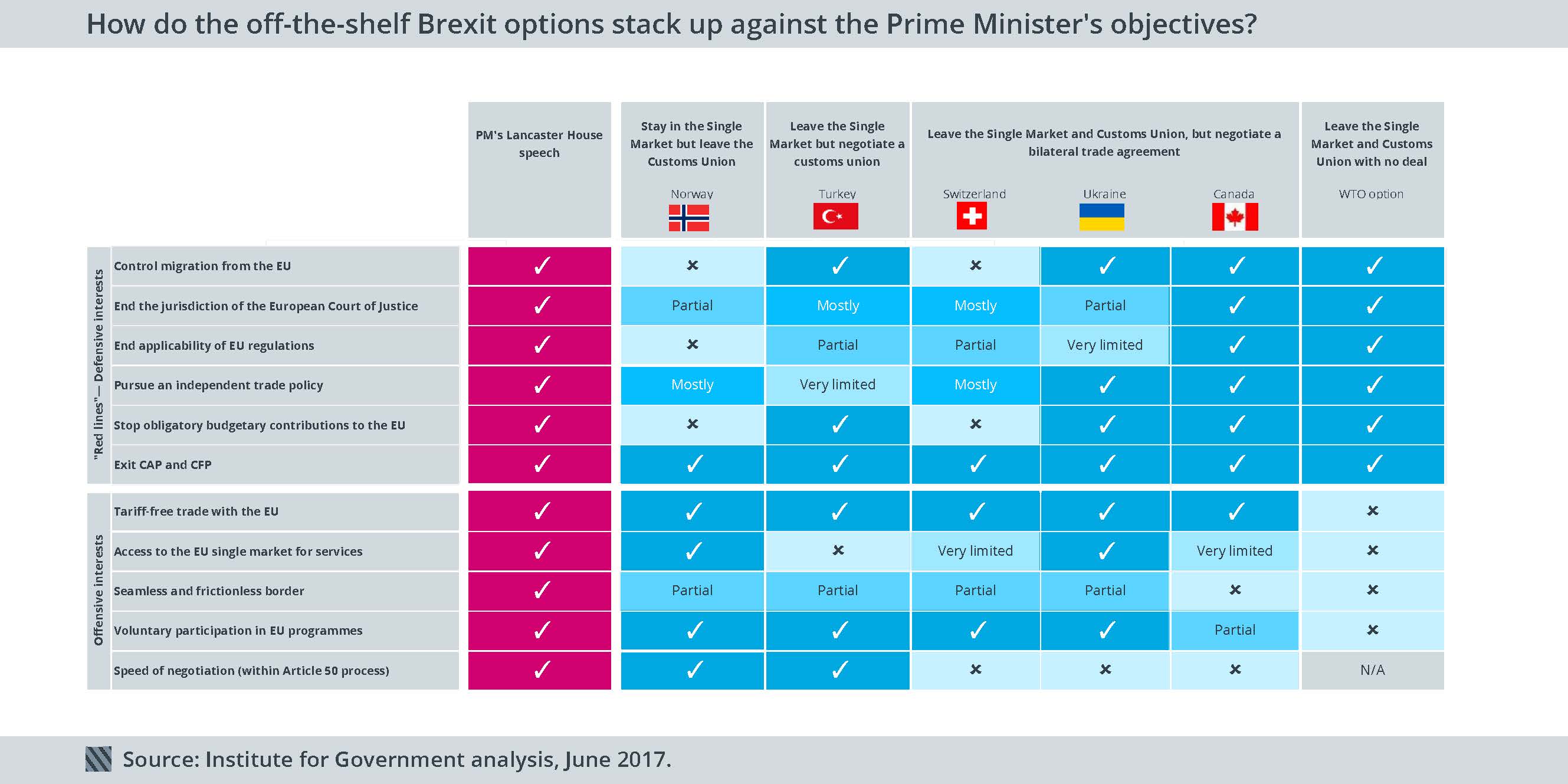
I thought that would have to be what the issue is - or could be. However, the following graphic is interesting. I post it because I think it may be of broader interest than simply the matter we are discussing.

Trade%20options%20new%20v2.jpg


Note the "Ukraine" and "Switzerland" options which seems to imply access to services is possible to negotiate an agreement which includes services. That would appear to be in contradiction with the information you provided. I am not saying they are right and you (your source) is wrong, but I think it may not be cut and dried either way.
 
I thought that would have to be what the issue is - or could be. However, the following graphic is interesting. I post it because I think it may be of broader interest than simply the matter we are discussing.

Trade%20options%20new%20v2.jpg


Note the "Ukraine" and "Switzerland" options which seems to imply access to services is possible to negotiate an agreement which includes services. That would appear to be in contradiction with the information you provided. I am not saying they are right and you (your source) is wrong, but I think it may not be cut and dried either way.

Of course it’s possible to negotiate a FTA that includes services. I personally regard it as incredibly unlikely for a number of reasons, some of which are technical, some economic some political and some practical.

The technical is that IF we did that, under the terms of their existing trade agreements the EU are contractually obliged to offer the same terms to countries like Canada, South Korea and Japan that they offer to us. That’s just what the contract says, and it is a clear disincentive.

The economic is that we are the world’s leading service provider. We batter the EU. We know it and they know it. Whilst the EU as a whole did not want us to leave their financial centres are fucking skipping about it. They are delighted. Already a sum that is now vastly in excess of £1trillion has migrated from London to the continent. The general election was about whether we might get that back. The result means we won’t, and we will probably lose more, though most of the money that was going to go has probably gone already. Opening up European financial service markets to the UK after the UK has unilaterally handed over a fuckton of its business to Europe really would be Turkeys voting for Christmas. The people of Blyth may not know what they have done, but the people of Brussels do, and they won’t repeat our mistake. We have given them a financial advantage equivalent to around 5% of our GDP. They won’t want to hand it back in a hurry.

The political is that it would cross the EU’s own red lines. I agree with you that we could probably negotiate, eventually, something close to fariff and quota free trade. So we retain free movement, in effect, of goods and capital, although we would have to contribute to EU coffers and submit to the ECJ jurisdiction. If we retain also free movement of services what it means is that we have kept three of the four freedoms while ditching freedom of movement. That is the very thing the EU set it’s face against us doing during the Cameroon negotiations and they have consistently said the same thing since the referendum. I don’t think they will give us via the back door that which they have so vocally said we cannot have via the front.

The practical is that the Prime Minister has (in effect) said this needs to get done by the end of next year or we leave on no deal terms. A FTA that made major concessions on services hasn’t been done before ever, so we would be starting from scratch and it is going to take a substantial period of time. This is not going to get done in a month of Sundays, never mind 12 months.

PS. Note the areas where Ukraine crosses our own red lines - eg acceptance of EU regulations and submission to the ECJ jurisdiction, and Switzerland’s acceptance of FOM. A comprehensive FTA including services that does not cross the stated red lines of the EU and the UK is, IMO, impossible. Something somewhere has to give.
 
Of course it’s possible to negotiate a FTA that includes services. I personally regard it as incredibly unlikely for a number of reasons, some of which are technical, some economic some political and some practical.

The technical is that IF we did that, under the terms of their existing trade agreements the EU are contractually obliged to offer the same terms to countries like Canada, South Korea and Japan that they offer to us. That’s just what the contract says, and it is a clear disincentive.

The economic is that we are the world’s leading service provider. We batter the EU. We know it and they know it. Whilst the EU as a whole did not want us to leave their financial centres are fucking skipping about it. They are delighted. Already a sum that is now vastly in excess of £1trillion has migrated from London to the continent. The general election was about whether we might get that back. The result means we won’t, and we will probably lose more, though most of the money that was going to go has probably gone already. Opening up European financial service markets to the UK after the UK has unilaterally handed over a fuckton of its business to Europe really would be Turkeys voting for Christmas. The people of Blyth may not know what they have done, but the people of Brussels do, and they won’t repeat our mistake. We have given them a financial advantage equivalent to around 5% of our GDP. They won’t want to hand it back in a hurry.

The political is that it would cross the EU’s own red lines. I agree with you that we could probably negotiate, eventually, something close to fariff and quota free trade. So we retain free movement, in effect, of goods and capital, although we would have to contribute to EU coffers and submit to the ECJ jurisdiction. If we retain also free movement of services what it means is that we have kept three of the four freedoms while ditching freedom of movement. That is the very thing the EU set it’s face against us doing during the Cameroon negotiations and they have consistently said the same thing since the referendum. I don’t think they will give us via the back door that which they have so vocally said we cannot have via the front.

The practical is that the Prime Minister has (in effect) said this needs to get done by the end of next year or we leave on no deal terms. A FTA that made major concessions on services hasn’t been done before ever, so we would be starting from scratch and it is going to take a substantial period of time. This is not going to get done in a month of Sundays, never mind 12 months.

PS. Note the areas where Ukraine crosses our own red lines - eg acceptance of EU regulations and submission to the ECJ jurisdiction, and Switzerland’s acceptance of FOM. A comprehensive FTA including services that does not cross the stated red lines of the EU and the UK is, IMO, impossible. Something somewhere has to give.

I am not debating the timing issue. That is a seperate point and an FTA which includes services may be impossible by end 2020, so let's not debate that. What I was questioning was your earlier claim that an FTA which includes services was impossible. When we drilled down into that a little, we got a position where you are suggesting it is impossible because that would necessitate the EU giving same to other countries such as Canada.

My retort - having had very little opportunity to read up further - is that it would appear that the Ukraine - for example - does indeed have an agreement which covers services. So there is clearly more to it that the article you linked earlier, implies. I note you are now saying an FTA with services is possible.

And as to red lines, well we'll see. Of course the EU's current position is that the four freedoms are inseparable, but they have never been faced with the world's 5th or 6th largest economy leaving them before, nor the prospect of Singapore_on_Thames on their doorstep. Nor a credible threat from a UK PM to implement such.

Personally I do think we'll get some kind of limited deal done by December 2020 because neither side wants us to crash out without a deal. I think it will be a limited agreement which provides some provisions for goods and capital and a longer transition period on areas not yet covered, such as services. That may run for years since doing nothing and keeping the status quo may be more politically acceptable than grasping the nettle and both sides making compromises which cross red lines.
 
Absolutely spot on

There is a 'movement' by some to try and place the blame anywhere else other than where the major issue was

I posted this in the leadership thread but didn't get any response - and don't think by asking this question it is a defence of Corbyn - but apart from the nation wanting Brexit and Corbyn's flakey stance on it, I cannot think of any reason why from June 2017 to December 2019 2 million people went from voting Labour to not voting Labour as all the alleged antisemitism/terror links have been there for years, haven't they? Or have I missed something, because to me he's always been presented as someone that could be viewed in this way?
 
I posted this in the leadership thread but didn't get any response - and don't think by asking this question it is a defence of Corbyn - but apart from the nation wanting Brexit and Corbyn's flakey stance on it, I cannot think of any reason why from June 2017 to December 2019 2 million people went from voting Labour to not voting Labour as all the alleged antisemitism/terror links have been there for years, haven't they? Or have I missed something, because to me he's always been presented as someone that could be viewed in this way?
Correct. Remainers in the Labour party showed the middle finger to their constituents and have now reaped the reward. Watching them all crying and blaming Corbyn who was landed with the 2nd referendum policy by Remainers like Starmer and Thornberry who now want to lead the party is quite ironic.
 

Don't have an account? Register now and see fewer ads!

SIGN UP
Back
Top