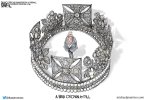
The British Monarchy

Sorry that the Queen has died, she has been extraordinary. Not sure about Charles though will give him a chance. Not happy with Andrew’s appearance. I would have welcomed some hiving off of the hangers on at this opportunity in these very different times to when I was born. Always upheld the family but my loyalty is definitely waining now
 
But you can guarantee our Prime Ministers or at least some of them with their ego's and messiah complexes would love to be something akin to an American president. The Irish presidents and Toaiseach's in my lifetime with the possible exception of Charles Haughey seem to be a bit less ego driven and from the outside looking in far more bearable.
Loads to debate in there.
Charlie was a special kind but not a one off.
He came from a party of ego starting with De Valera.

Like I said. It was just a point of clarification. At the end of the day it is up to the British people to decide. I suppose some are suggesting in here that they currently have no say. That’s your business.
Taoiseach and Uachtaran are two very different roles. Uachtaran has evolved into a dignified a-political statesmanlike role that has been carried out very dutifully and eloquently over the past three occupiers of the Aras an Uachtaran.
 
Secondly, do you think it’s fair footballers on 200k a week can have massive mansions and their sons and daughters won’t need to work a day in their life? Same for Music stars and actors etc
It isn't given to them by the taxpayer.
They have a rare talent and it has big rewards.
They actually pay the government in taxes.
The Royal's get free money from you the taxpayer and you have no say in that.
 
It isn't given to them by the taxpayer.
They have a rare talent and it has big rewards.
They actually pay the government in taxes.
The Royal's get free money from you the taxpayer and you have no say in that.
Bill are you more upset that Charles is head of state of Australia or would it suffice if Australia opted out.

I’m not saying I disagree with any of your arguments but it really seems to rile you, whereas in my shoes I can sort of figure, well I wouldn’t go for it, but if it’s what you want, knock yourselves out.

Now when it comes to unpicking the mess in NI then you may see a rise in my blood pressure, but that’s a different story.
 
So you'd rather we were ruled over by people who werent elected and have simply inherited the right to rule by convincing people it was given to them by god?
Couldn’t agree more - when you think about it it’s a preposterous concept that belongs back in the day when people believed in dragons and witches. You did forget to mention though that although it was part God it was also down to them murdering, raping, stealing, bullying etc that they were able to create a monarchy. Putinesque behaviour in other words.
 
The Queen inherited her right by the god “Odin”, that’s how far back her ancestry goes. I think he was a Norse god!
Yes I’m happy its not the 17th century and we all know they are human but it’s preferable to any other system for me.
The devil I know is preferable to the one I don’t.

In some ways democracy is quite young the rules have evolved and it leaves a gap for people to agitate for change I am happy I won’t change my view on our democracy.
Democracy is actually a relatively mad concept because do the people really know what they want? Look at how politics has evolved over the last 10 years and that's all in the name of democracy. The folk who slag this government off everyday on here seem to forget that it's their fellow country folk who put them there.

The anger around all of that just proves that nobody wants democracy anyway, they just want their form of democracy and it's just tolerance of opinion that is really falling apart. When tolerance falls apart you end up with some kind of anarchy resulting in lunatics like Trump in charge which is where the US is probably going again.

The only balancer between relatively dodgy people or lunatics getting their way is something above that like the monarchy. In the US they split the presidency, congress and house of representatives for a reason.... It otherwise would only take one crazy president and it all goes to pot and that's why Russia is in the mess it is.

It's an odd one really, you'll find many who are highly in favour of the monarchy and many who want rid of the royal family but you'll always find far more who are fully in favour of burning Parliament down.... That's where we are...
 
I'm really torn on this, but thinking objectively you have to support an elected head of state over an unelected one. Whilst I strongly believe that the Queen did a decent job and a far better one than Boris would have done - and he would have been elected as Head of State. That shouldn't be my measure. We should demand more of our politicians and as long as they've been elected we'd only have ourselves to blame but they'd be in that role through the correct principles and not because they were born to it (although arguably being born to wealth and then attending Eton is a pre-requisite for a lot of Tories). We need proportional representation though, that is critical change.
 
Indifferent for me - basically there are no rational grounds for having a monarchy, but the alternative of an elected Head of State leaves me cold.

Harry for King! We could do with cheering up.
 
There are different types of communism, I was asking what yours is. Do you want all men equal? Or just their finances? How would you distribute wealth so that wealthy people need not feel guilty for having a big house?

Saw this post yesterday but have not had a chance to respond until now.

These are excellent questions. The philosopher John Rawls came up with an influential response to them in his book A Theory of Justice.

In particular, he is renowned for an influential thought experiment that he described in this publication. He asks us to imagine that we are to become a member of a new society but presently know nothing about what role we will play in it. For example, we don’t know if we will be rich, poor, able-bodied, good looking, male, female, intelligent, unintelligent, talented or unskilled, and we won’t know which ethnic group we will belong to or what our sexual proclivities might be. Rawls thought that in our currently prior state (which he called the Original Position), where we have to collectively decide in advance from behind a ‘veil of ignorance’ on the rules that will govern our new world, that we would be rationally attracted to choosing ones that could improve our situation if we ended up disadvantaged in some way. Specifically, he thought that it would be rational to accept two fundamental principles: those of Freedom and Equality.

The first principle is one that would maximise a range of freedoms for all citizens, such as being able to vote for who governs you and extensive freedom of expression, while the second, which is also called the Difference Principle, would ensure more equal levels of wealth and opportunity. For example, although some people might be paid very high salaries, this would only be permitted if lower paid workers somehow received more money because of this arrangement, more than they would if the highest paid citizens were paid less. Rawls also thought that those who are endowed with natural talents, such as intelligence or sporting ability were not necessarily entitled to more money, as being blessed in this way is mainly due to luck and good genes.

Interestingly, although Rawls's discussion is theoretical, there is some empirical evidence to support his view.

In their recent books, The Spirit Level and The Inner Level, epidemiologists Richard Wilkinson and Kate Pickett show that the more unequal a society is, the more people suffer from a variety of physical and mental health problems, such as obesity and depression. Additionally, drug abuse tends to be rife, rates of imprisonment and teenage pregnancies are higher, social mobility is less possible, trust between citizens is lower, and violence is more endemic. In other words, outcomes are significantly worse in more unequal rich countries like the US and UK.

Am just coming to the end of False Dawn: The Delusions of Global Capitalism by John Gray. He takes a similar line.

All this suggests that we should aim, not for a fully egalitarian society (as we know, the attempts to do away with markets altogether proved disastrous in Russia and China under Communism) but for a more egalitarian society here.

 
Last edited:
@twosips A child rapist has been given the job of stepping in and representing the king if he's ill, but don't worry it's "probably in charge of the pen's ink filling"
I see the know all tag team are pushing another debate ;)
Honestly, where do you get the time.
 
Saw this post yesterday but have not had a chance to respond until now.

These are excellent questions. The philosopher John Rawls came up with an influential response to them in his book A Theory of Justice.

In particular, he is renowned for an influential thought experiment that he described in this publication. He asks us to imagine that we are to become a member of a new society but presently know nothing about what role we will play in it. For example, we don’t know if we will be rich, poor, able-bodied, good looking, male, female, intelligent, unintelligent, talented or unskilled, and we won’t know which ethnic group we will belong to or what our sexual proclivities might be. Rawls thought that in our currently prior state (which he called the Original Position), where we have to collectively decide in advance from behind a ‘veil of ignorance’ on the rules that will govern our new world, that we would be rationally attracted to choosing ones that could improve our situation if we ended up disadvantaged in some way. Specifically, he thought that it would be rational to accept two fundamental principles: those of Freedom and Equality.

The first principle is one that would maximise a range of freedoms for all citizens, such as being able to vote for who governs you and extensive freedom of expression, while the second, which is also called the Difference Principle, would ensure more equal levels of wealth and opportunity. For example, although some people might be paid very high salaries, this would only be permitted if lower paid workers somehow received more money because of this arrangement, more than they would if the highest paid citizens were paid less. Rawls also thought that those who are endowed with natural talents, such as intelligence or sporting ability were not necessarily entitled to more money, as being blessed in this way is mainly due to luck and good genes.

Interestingly, although Rawls's discussion is theoretical, there is some empirical evidence to support his view.

In their recent books, The Spirit Level and The Inner Level, epidemiologists Richard Wilkinson and Kate Pickett show that the more unequal a society is, the more people suffer from a variety of physical and mental health problems, such as obesity and depression. Additionally, drug abuse tends to be rife, rates of imprisonment and teenage pregnancies are higher, social mobility is less possible, trust between citizens is lower, and violence is more endemic. In other words, outcomes are significantly worse in more unequal rich countries like the US and UK.

Am just coming to the end of False Dawn: The Delusions of Global Capitalism by John Gray. He takes a similar line.

All this suggests that we should aim, not for a fully egalitarian society (as we know, the attempts to do away with markets altogether proved disastrous in Russia and China under Communism) but for a more egalitarian society here.
I very much doubt @mexico1970 was asking me with this reasoning!!
 
Saw this post yesterday but have not had a chance to respond until now.

These are excellent questions. The philosopher John Rawls came up with an influential response to them in his book A Theory of Justice.

In particular, he is renowned for an influential thought experiment that he described in this publication. He asks us to imagine that we are to become a member of a new society but presently know nothing about what role we will play in it. For example, we don’t know if we will be rich, poor, able-bodied, good looking, male, female, intelligent, unintelligent, talented or unskilled, and we won’t know which ethnic group we will belong to or what our sexual proclivities might be. Rawls thought that in our currently prior state (which he called the Original Position), where we have to collectively decide in advance from behind a ‘veil of ignorance’ on the rules that will govern our new world, that we would be rationally attracted to choosing ones that could improve our situation if we ended up disadvantaged in some way. Specifically, he thought that it would be rational to accept two fundamental principles: those of Freedom and Equality.

The first principle is one that would maximise a range of freedoms for all citizens, such as being able to vote for who governs you and extensive freedom of expression, while the second, which is also called the Difference Principle, would ensure more equal levels of wealth and opportunity. For example, although some people might be paid very high salaries, this would only be permitted if lower paid workers somehow received more money because of this arrangement, more than they would if the highest paid citizens were paid less. Rawls also thought that those who are endowed with natural talents, such as intelligence or sporting ability were not necessarily entitled to more money, as being blessed in this way is mainly due to luck and good genes.

Interestingly, although Rawls's discussion is theoretical, there is some empirical evidence to support his view.

In their recent books, The Spirit Level and The Inner Level, epidemiologists Richard Wilkinson and Kate Pickett show that the more unequal a society is, the more people suffer from a variety of physical and mental health problems, such as obesity and depression. Additionally, drug abuse tends to be rife, rates of imprisonment and teenage pregnancies are higher, social mobility is less possible, trust between citizens is lower, and violence is more endemic. In other words, outcomes are significantly worse in more unequal rich countries like the US and UK.

Am just coming to the end of False Dawn: The Delusions of Global Capitalism by John Gray. He takes a similar line.

All this suggests that we should aim, not for a fully egalitarian society (as we know, the attempts to do away with markets altogether proved disastrous in Russia and China under Communism) but for a more egalitarian society here.
As a general rule I refuse to read anything longer than a paragraph but I hung in there and that was pretty good.
 
I wouldn't mind so much if the King had 1 fucking house.
All these Palaces, Castles, Stately Homes, incorporating thousands of rooms....thousands of acres of prime British countryside for one fucking family. How working class people think that's ok befuddles me.

These people have zero clue how normal people live, waiting for surgeries, paying mortgages, struggling to stay warm in winter on a housing estate.
Neither do footballers but you support the club ?
 

Don't have an account? Register now and see fewer ads!

SIGN UP
Back
Top