Andy Burnham | Manchester Mayor

OK, as requested.

So, going back to what City have paid for the stadium. The facts used to be online at the Sport England website, but no longer are. Fortunately, at the time we moved, I used to write articles for a City fan site. They're no longer available but I retained my notes from one I wrote about the stadium. The terms on which we moved and other salient facts are as follows:
  1. Of the original GBP 110 million cost of the stadium, including the planned conversion to a football stadium, GBP 77 million was to be funded by Sports England grants from lottery funds and GBP 33 million was to be funded by Manchester City Council.
  2. Owing to cost overruns on the project, Sport England subsequently provided another GBP 20 million in grants.
  3. The cost of constructing a temporary stadium for the 2002 Games with a capacity of around 30K that would have been scaled back to an athletics venue of 8K to 10K would have been in the region of GBP 60 million.
  4. Though City agreed in principle in September 1998 to take a long-term lease of a permanent stadium appropriately converted for football, a binding contract to that effect wasn't signed until August 1999 - and Gary James has suggested that the deal may well never have been signed off on the Council/Sport England side had we not been promoted from the third tier around 10 weeks previously.
  5. As part of the deal, City agreed to make parts of the stadium available for community use on 100 days each year. I don't know what happens in practice, but this is the contractual commitment.
  6. City agreed to reimburse the Council's GBP 33 million paid towards construction in return for being granted a managing lease, under which we'd retain all money from additional use of the stadium for concerts, other sporting events and the like. We could, as happened with West Ham at Stratford, have done a deal whereby we'd have been a priority tenant, paid nothing towards the construction of the venue in the form we were to move into, and the Council would have reaped all the benefit from other use.
  7. This GBP 33 million was funded by way of a GBP 6 million cash payment and by the transfer of Maine Road (valued at GBP 27 million) into the Council's ownership.
  8. The value of Maine Road was somewhat controversial. Accountant Paul Stanley, a partner at Begbies Traynor who used to review City's accounts in the 1990s for the King of the Kippax fanzine under the alias 'Stan the Man' once called this "the most dubious accounting valuation I've ever come across", and he didn't mean it was undervalued.
  9. The Council's original intention was to lease out Maine Road as a sports venue, with Sale Sharks and Stockport County (seriously!) putting themselves forward for preferred bidder status. Sale won that battle but ultimately bottled out of taking their posh fans to Moss Side, so the site was sold for housing. It was reported at the time, based on information gained pursuant to an FoI request, that the Council received approximately GBP 14 million from the developer.
  10. In addition, we were to pay rent based on a percentage of the take from attendances in excess of the capacity at Maine Road when the lease was signed: 40% of net revenue from spectators between 34.5K and 41K, and 60% of net revenue generated by spectators in excess of 41K.
  11. This money was ringfenced and couldn't be used towards the Council's ordinary budgetary requirements. It was applied towards the upkeep of sporting facilities, including those on what was then referred to as the Sport City site around the stadium, which the Council claimed in the mid-2000s to attract 3 million visitors per annum outside MCFC home games (this seems a dubious figure, but it's what they claimed).
  12. In 2011, before the Etihad naming deal was signed, the Manchester Evening News claimed that MCFC had paid the Council GBP 14 million in rent over the first eight years of occupancy at the new stadium. I think from memory that this figure came from an FoI
  13. In 2011, the lease was amended by agreement between the parties to reflect City's possible desire to expand the stadium as well as to grant the club the right to sell naming rights for the stadium, which the lease hadn't previously allow. In return, the club agreed (according to David Conn reporting in The Guardian) to pay the Council GBP 3 million per annum in rent and a further GBP 1 million annually for the right to dispose of naming rights.
  14. @Gordyiola has produced information from an FoI request suggesting that the figure, at least before the South Stand was expanded in 2015, the rental figure was higher than that reported by Conn. I'm going to stick to GBP 4 million in my calculations just because it's an easy, round figure.
We can see from the above that the Council has thus, as at the summer of 2025, will have received the following from the club with regard to the stadium:

(i) GBP 6 million as our cash contribution to the construction costs for the stadium; (ii) GBP 14 million realised from the asset (Maine Road) that we transferred at the same time; (iii) GBP 14 million in rent from August 2003 to summer 2011 (inclusive); and (iv) an estimated GBP 56 million in rent and compensation for the disposal of naming rights from August 2011 to August 2021 (inclusive).

Thus, in contrast to what our detractors say when they maintain we received the stadium for nothing, we reach a figure in the ballpark of GBP 90 million paid up to the summer of 2025. If this number is slightly out, then it won't be by very much at all.

Other points worth noting:
  1. As has been noted on many occasions before, though United did enter negotiations to use a larger stadium on the Commonwealth site that was eventually built, by 1999 City were decisively the only show in town, as point 4 above suggests. Had this stadium not been built for City, the Games would have been held in a 30,000-seater temporary venue then (as at Victoria, Canada in 1994) scaled back to a much smaller athletics stadium of 10,000 seats or less. Sport England put the cost of that option at GBP 60 million but the resultant venue would have had almost zero potential as the catalyst for major regeneration in East Manchester.
  2. By building a stadium that City could use as opposed to one where the sole Commonwealth Games legacy at the site would be a small athletics stadium, Sport England estimated that the Council had incurred an additional GBP 70 million of costs. Thus, the public purse has received far more than just its money back on the amount attributable to creating a new stadium fit for MCFC's use and stands to generate a further GBP 4 million annually for years to come, until MCFC is in a position to exercise the option it has to buy out the freehold under the lease.
  3. Further, there's been over 20 years of community use of the stadium, but we should also note that an arrangement is in force under which the rent paid to MCC by MCFC for use of the stadium is ring-fenced for sporting use, so can't be applied by MCC towards meeting its general budgetary needs. This was a stipulation in the original conditions for the grant by Sport England of funding to allow the stadium to be built for the Commonwealth Games and then leased to us afterwards.
  4. The above arrangement has allowed MCC to maintain the other sporting facilities around the stadium when other local authorities, in this long era of austerity and cost-cutting, have sought to save cash by closing similar facilities. A great example is Sheffield, where the 25,000-seater Don Valley athletics stadium and Ponds Forge international-standard swimming pool have been demolished as the local council there couldn't afford to fund their upkeep

TL, DR - The Council and Sport England have received fucking fantastic benefits from building a stadium for City to move into once the Commonwealth Games were over, even if you say nothing about the additional benefits for and investment in East Manchester brought by the owners attracted to the club in 2008. I haven't even started on that.
Great stuff
 
Nothing more to tell actually.

The plans & CGGs exist & are revisited/updated ongoing.

City will aquire all developable land as the opportunity's arise.

Trains,Trams,Stations & Hubs will all be expanded/developed in line with the long term master plan.

Take a look at Saadiyat & Yas as examples of the art of the possible.

We're only just starting !!
I'll second this. Pretty well as soon as the ink was dry on the takeover documents, there were two proof of concepts drawn up for new stadiums. One for a 75-80k seater stadium on the site of the North Car Park and another (the preferred option) for a 100k-seater stadium on the CFA site.
 
I'll second this. Pretty well as soon as the ink was dry on the takeover documents, there were two proof of concepts drawn up for new stadiums. One for a 75-80k seater stadium on the site of the North Car Park and another (the preferred option) for a 100k-seater stadium on the CFA site.

I’m sure that was mentioned in Omar’s interview……

The regeneration project is probably named “Project what City are doing!”
 
Nothing more to tell actually.

The plans & CGGs exist & are revisited/updated ongoing.

City will aquire all developable land as the opportunity's arise.

Trains,Trams,Stations & Hubs will all be expanded/developed in line with the long term master plan.

Take a look at Saadiyat & Yas as examples of the art of the possible.

We're only just starting !!
Wow thank you so much for the info
 
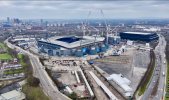
Andy, can City have some Government and tax payer funding to develop the Collar site?

It’s the large parcel of land currently being used as a car park opposite the Etihad stadium.

The rumoured plans for the Collar site could create ‘1000’s of job opportunities’.(but not 90,000 job opportunities)

Picture credit CP Overview.

IMG_4936.jpeg
 
OK, as requested.

So, going back to what City have paid for the stadium. The facts used to be online at the Sport England website, but no longer are. Fortunately, at the time we moved, I used to write articles for a City fan site. They're no longer available but I retained my notes from one I wrote about the stadium. The terms on which we moved and other salient facts are as follows:
  1. Of the original GBP 110 million cost of the stadium, including the planned conversion to a football stadium, GBP 77 million was to be funded by Sports England grants from lottery funds and GBP 33 million was to be funded by Manchester City Council.
  2. Owing to cost overruns on the project, Sport England subsequently provided another GBP 20 million in grants.
  3. The cost of constructing a temporary stadium for the 2002 Games with a capacity of around 30K that would have been scaled back to an athletics venue of 8K to 10K would have been in the region of GBP 60 million.
  4. Though City agreed in principle in September 1998 to take a long-term lease of a permanent stadium appropriately converted for football, a binding contract to that effect wasn't signed until August 1999 - and Gary James has suggested that the deal may well never have been signed off on the Council/Sport England side had we not been promoted from the third tier around 10 weeks previously.
  5. As part of the deal, City agreed to make parts of the stadium available for community use on 100 days each year. I don't know what happens in practice, but this is the contractual commitment.
  6. City agreed to reimburse the Council's GBP 33 million paid towards construction in return for being granted a managing lease, under which we'd retain all money from additional use of the stadium for concerts, other sporting events and the like. We could, as happened with West Ham at Stratford, have done a deal whereby we'd have been a priority tenant, paid nothing towards the construction of the venue in the form we were to move into, and the Council would have reaped all the benefit from other use.
  7. This GBP 33 million was funded by way of a GBP 6 million cash payment and by the transfer of Maine Road (valued at GBP 27 million) into the Council's ownership.
  8. The value of Maine Road was somewhat controversial. Accountant Paul Stanley, a partner at Begbies Traynor who used to review City's accounts in the 1990s for the King of the Kippax fanzine under the alias 'Stan the Man' once called this "the most dubious accounting valuation I've ever come across", and he didn't mean it was undervalued.
  9. The Council's original intention was to lease out Maine Road as a sports venue, with Sale Sharks and Stockport County (seriously!) putting themselves forward for preferred bidder status. Sale won that battle but ultimately bottled out of taking their posh fans to Moss Side, so the site was sold for housing. It was reported at the time, based on information gained pursuant to an FoI request, that the Council received approximately GBP 14 million from the developer.
  10. In addition, we were to pay rent based on a percentage of the take from attendances in excess of the capacity at Maine Road when the lease was signed: 40% of net revenue from spectators between 34.5K and 41K, and 60% of net revenue generated by spectators in excess of 41K.
  11. This money was ringfenced and couldn't be used towards the Council's ordinary budgetary requirements. It was applied towards the upkeep of sporting facilities, including those on what was then referred to as the Sport City site around the stadium, which the Council claimed in the mid-2000s to attract 3 million visitors per annum outside MCFC home games (this seems a dubious figure, but it's what they claimed).
  12. In 2011, before the Etihad naming deal was signed, the Manchester Evening News claimed that MCFC had paid the Council GBP 14 million in rent over the first eight years of occupancy at the new stadium. I think from memory that this figure came from an FoI
  13. In 2011, the lease was amended by agreement between the parties to reflect City's possible desire to expand the stadium as well as to grant the club the right to sell naming rights for the stadium, which the lease hadn't previously allow. In return, the club agreed (according to David Conn reporting in The Guardian) to pay the Council GBP 3 million per annum in rent and a further GBP 1 million annually for the right to dispose of naming rights.
  14. @Gordyiola has produced information from an FoI request suggesting that the figure, at least before the South Stand was expanded in 2015, the rental figure was higher than that reported by Conn. I'm going to stick to GBP 4 million in my calculations just because it's an easy, round figure.
We can see from the above that the Council has thus, as at the summer of 2025, will have received the following from the club with regard to the stadium:

(i) GBP 6 million as our cash contribution to the construction costs for the stadium; (ii) GBP 14 million realised from the asset (Maine Road) that we transferred at the same time; (iii) GBP 14 million in rent from August 2003 to summer 2011 (inclusive); and (iv) an estimated GBP 56 million in rent and compensation for the disposal of naming rights from August 2011 to August 2021 (inclusive).

Thus, in contrast to what our detractors say when they maintain we received the stadium for nothing, we reach a figure in the ballpark of GBP 90 million paid up to the summer of 2025. If this number is slightly out, then it won't be by very much at all.

Other points worth noting:
  1. As has been noted on many occasions before, though United did enter negotiations to use a larger stadium on the Commonwealth site that was eventually built, by 1999 City were decisively the only show in town, as point 4 above suggests. Had this stadium not been built for City, the Games would have been held in a 30,000-seater temporary venue then (as at Victoria, Canada in 1994) scaled back to a much smaller athletics stadium of 10,000 seats or less. Sport England put the cost of that option at GBP 60 million but the resultant venue would have had almost zero potential as the catalyst for major regeneration in East Manchester.
  2. By building a stadium that City could use as opposed to one where the sole Commonwealth Games legacy at the site would be a small athletics stadium, Sport England estimated that the Council had incurred an additional GBP 70 million of costs. Thus, the public purse has received far more than just its money back on the amount attributable to creating a new stadium fit for MCFC's use and stands to generate a further GBP 4 million annually for years to come, until MCFC is in a position to exercise the option it has to buy out the freehold under the lease.
  3. Further, there's been over 20 years of community use of the stadium, but we should also note that an arrangement is in force under which the rent paid to MCC by MCFC for use of the stadium is ring-fenced for sporting use, so can't be applied by MCC towards meeting its general budgetary needs. This was a stipulation in the original conditions for the grant by Sport England of funding to allow the stadium to be built for the Commonwealth Games and then leased to us afterwards.
  4. The above arrangement has allowed MCC to maintain the other sporting facilities around the stadium when other local authorities, in this long era of austerity and cost-cutting, have sought to save cash by closing similar facilities. A great example is Sheffield, where the 25,000-seater Don Valley athletics stadium and Ponds Forge international-standard swimming pool have been demolished as the local council there couldn't afford to fund their upkeep

TL, DR - The Council and Sport England have received fucking fantastic benefits from building a stadium for City to move into once the Commonwealth Games were over, even if you say nothing about the additional benefits for and investment in East Manchester brought by the owners attracted to the club in 2008. I haven't even started on that.
Superb post. And in addition to this £90m the council has netted multi million pounds in council and business taxes because of the re-regeneration of Ancoats and Beswick (soon to be Holt Town as well). None of this would have happened without the huge investment by Sheikh Mansour. The Etihad stadium deal must be the best deal ever made by any local council in this country. It has been fantastic for the people of Manchester whatever the London-based media claims.
 
As an aside….
Does the athletics track/stadium get used for much? Never seem to read or see much
Yes. For those that are unaware, it is part of facility that also has a 200m indoor track. Over the course of the winter there are a number of indoor events, including this morning. The indoor/outdoor tracks are accessed for training for a number of local athletics clubs. The outdoor track has also recently been resurfaced and has hosted a few international meetings and the English Schools Athletics event over the couple of years. It also hosted last year's national championships/Olympic trials.
 
Copied from Rail .com:
“The developer is to hand over 16-acres of Green Belt to the council in exchange for nine-acres needed to progress plans for a rail link designed to unlock land for the 3.4m sq ft logistics scheme.

The proposed rail spur would connect the Manchester to Liverpool train line in the south-west of the borough to the £56m freight rail terminal at the £60m Port Salford, Peel L&P’s multi-modal logistics scheme on the banks of the Manchester Ship Canal.

James Whittaker, Peel L&P’s executive director of development, said: “We’re pleased to be working in partnership with the council to bring the rail terminal forward, which will create at least 2,500 jobs and secure a reduction in CO2 emissions of 14,900 tonnes a year by taking freight movements off the road.”

So far, around 300,000 sq ft of industrial accommodation, occupied by logistics companies Great Bear and Rhenus, has been developed.

However, the next phase of warehouses, totalling 1.3m sq ft, cannot be built until the rail link is in place.

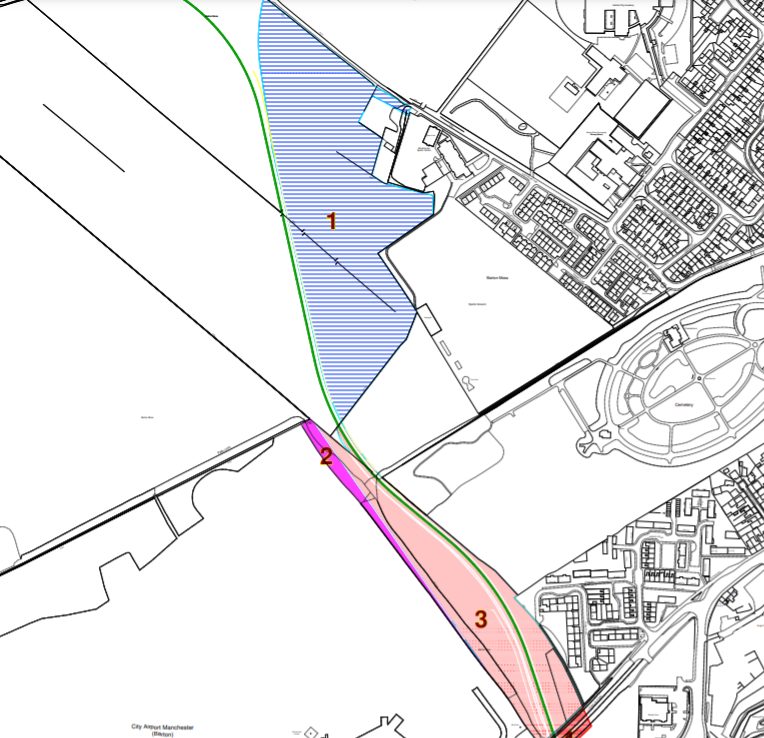
Under the terms of the land deal, to be approved by Salford City Council next Monday, Peel Investments would swap a swathe of agricultural land bordering Salford City Academy for a smaller plot between City Airport and Peel Green Cemetery.

Peel And Salford Land Swap
Peel will swap the area in blue for the area in red
The proposed rail spur would cut through the site before crossing Liverpool Road and connecting to the rail terminal west of the AJ Bell Stadium.

Port Salford could lever £140m of private sector investment and create at least 2,500 jobs, according to a report to Salfor City Council’s property and regeneration committee.

The project forms part of the wider Ocean Gateway growth plan for the North West to revitalise the Manchester Ship Canal Corridor, and is included within the Liverpool City Region freeport bid to the Government.

The land that Salford City Council is to acquire from Peel Investments under the terms of the land swap could be used for tree planting, according to the report. “

March 2021​

Copied from Rail UK.com
This freightliner move has been going on for quite some time yet I had no idea of a plan to purchase 16acres of green belt land in order to create a spur on the other rail link to Liverpool, that goes through Wigan
 
Stupid is, as stupid asks.

Don't you know the value of discretion ??
So, we're going to engage in juvenile name-calling are we? It was a reasonable question asked in good faith. It would have sufficed simply to say you weren't able to divulge your sources perhaps because the information was disclosed to you in confidence. Your comment says far more about you than me.
 
Last edited:
Tritax Big Box Developments is drawing upon proposals for an Intermodal Logistics Park North (ILP North) on the site.

The project would deliver a new strategic rail freight Interchange (SRFI) - a modern distribution and warehouse park linked to both the strategic rail freight and road networks.

It would aim to improve connections in the North West to local, regional, national and global markets.
St Helens Council's leader Anthony Burns has said such a development would bring huge growth opportunities to the borough.

This development is separate from a joint venture between St Helens Borough Council and Langtree which has already secured planning approval - after facing some stiff public opposition - for up to 2.6m square feet of logistics and advanced manufacturing space developed on the former colliery site“

Major infrastructure project​

Creating such a rail freight development, as planned by Tritax, has been in the St Helens borough's regeneration vision for two decades and the unveiling of the consultation programme - at a time when the Labour government is keen to accelerate economic growth by getting large scale infrastructure projects off the ground

The developer has made bold claims about the project, suggesting it "could create up to 6,000 jobs on site" and add about £175m per annum in gross value added (GVA) to the regional economy, following completion.


Creating the Intermodal Logistics Park North is regarded as an integral part of the Liverpool City Region Freeport, a special economic zone created by the Government to

0PThe consultation, which will include a number of meetings with residents, is described as "informal non-statutory".

Location between Liverpool and Manchester​

The Parkside site is strategically located between Liverpool and Manchester, which Tritax says benefits from excellent access to the UK’s West Coast Main Line (north-south) and Liverpool-Manchester TransPennine (east-west) rail freight infrastructure.

These rail links provide access to the UK’s coastal ports, offering potential to the pave way towards "a significant shift from road to rail freight to move goods in and out of the North West", Tritax has said.

ILP North could deliver up to c.767,000 sq. m. (c.8.2m sq. ft.) of warehousing and ancillary buildings with a total footprint of c.590,000 sq. m. (c.6.3m sq. ft.) and c.177,050 sq. m. (c.1.9m sq. ft.) of mezzanine floorspace

Consultation events​

Tritax Big Box Developments will be running a first round of consultation from Monday, January 27, 2025 until Friday, March 21.

Residents are encouraged to find out more by attending one of the following events:

• Monday, February 10 2025 at Crownway Community Centre, 2pm-7pm

• Thursday, February 13 2025 at Golborne Parkside Sports & Community Club, 2pm-7pm

• Friday, February 28 2025 at Winwick Leisure Centre, 2pm-7pm

• Saturday, March 1 2025 at Newchurch Parish Hall, 10am-2pm

See if you can read what will be happening at the St Helens end
Newton le Willows is quite up market they already have the M6 thundering past
 
• Wednesday, March 5 2025 – Online Webinar, 6.30pm-8pm from the St. Helens Star a local newspaper

How to give feedback​

Detailed information about the proposals, and how to provide feedback can be found at the project website: www.tritaxbigbox.co.uk/our-spaces/intermodal-logistics-park-north/.

The project team can also be contacted by email at ilpnorth@consultationonline.co.uk or by phone on 01744 802043.

People can also sign up for updates from the Planning Inspectorate PINS on their website: https://national-infrastructure-con...e.gov.uk/projects/TR0510001/get-updates/start.

Feedback on the proposals during this round of informal consultation will be accepted until 11:59pm on Friday 21, March 2025. The project will then be refined before it is presented for further consultation during the statutory consultation phase, anticipated to be undertaken at the end of 2025.


'Growth opportunities'​

David Travis, Head of Manchester Office at Tritax Big Box Developments said: “Our informal non-statutory consultation is a key milestone as we set out our early plans for ILP North in the Newton-le-Willows area.

"It has been a long-held ambition of St Helens Borough Council and the Liverpool City Region Combined Authority to bring such a development forward and we are delighted to be bringing their long-standing vision to fruition.

“The development of an SRFI at this location is an integral part of Liverpool City Region’s Freeport and is aligned with the UK Government’s target to increase rail freight by at least 75% by 2050; with potential to deliver a scheme of local, regional and national importance.


"The project is classed as a Nationally Significant Infrastructure Project, meaning that permission will be determined directly by the Government by way of the Development Consent Order (DCO) process.

“We are committed to working with the local community and other stakeholders to inform the quality and design of the project as we go through the various stages of the consenting process and look forward to commencing our initial engagement with them over the coming weeks.”

In a statement, Councillor Anthony Burns, leader of St Helens Borough Council, said: “The proposal to bring forwards Intermodal Logistics Park North as an integral part of the Parkside Freeport has the potential to bring in huge growth opportunities for our borough, create a range of jobs for our residents and support our current businesses through a wealth of supply chain opportunities during construction and operation.

"We have always recognised that this strategic site is of regional and national importance for both regeneration and the transition to net zero, given its unrivalled transport connections and Liverpool City Region Freeport Tax Site status.

"I would strongly encourage people to take part in the consultation, hear about the vision for this hugely important site and help influence its future outcomes.”

Meanwhile, Steve Rotheram, mayor of the Liverpool City Region said the development could be a "game-changer for the Newton-le-Willows area".

He said: "This is exactly the kind of investment we need to strengthen our position as a vital hub for trade and logistics.

"I’m particularly excited about the prospect of creating thousands of good, sustainable jobs."

“With its strategic location and the support of the Liverpool City Region Freeport, this project will help drive economic growth, improve connectivity, and open up new opportunities for local people. It’s great to see our vision for the future of places such as this taking shape, and I look forward to working with Tritax Big Box Developments and all our partners to make this a reality.”

How does this link to the Old Trafford development in Greater Manchester?​

Significantly, as reported last autumn, the development could reportedly pave the way for Tritax to agree a deal for the relocation of Freightliner, which occupies a large rail terminal site near Manchester United's Old Trafford stadium, to Parkside.

Manchester United have been drawing up plans for a massive regeneration project, including a new stadium, in the area of Trafford which Freightliner occupies.

Tritax's announcement today makes no reference to a potential move by Freightliner and the developer has not been drawn on those links previously

 

Don't have an account? Register now and see fewer ads!

SIGN UP
Back
Top