EU referendum

EU referendum

  • In

    Votes: 503 47.9%
  • Out

    Votes: 547 52.1%

  • Total voters
    1,050
Status
Not open for further replies.
That makes the decline in eu activity even more puzzling surely logic would tell you that there should be some correlation in the increase in Chinese activity and growth with an increase in European activity?

In answer to your question, it is wholly down to the austerity measures implemented by the eu
( read Germany) since 2010. Countries have had to internally devalue ( they have no currency to devalue) by taking wage cuts, jobs have been decimated, less public spending, banks restructuring their capital buffers in the eu and restricting lending for investments, bail outs and that's because they do not have the ability to treat individual errors separately because of the currency.

Depends what they produced and how much was exported and to whom.
They may well have an increased GDP as a result of domestic products.
Their 'growth' could and probably is largely internal, and there could be a lag between that growth and the rest of the world feeling the effects of it as they start to trade more.

So, for simplicities sake, they could spend billions producing beach ball making machines - which would show up on their GDP, and not do any exports. Then next period, they start making beachballs, also showing up on their GDP, and then export them - which THEN starts showing as correlating activity on Europe (or wherever they flog beachballs too)
 
Last edited:
Well then you're basically pinning the Uk's economic future on an ever decreasing economic block which makes most of the talk on here about potential future tariff levels outside of the eu irrelevant.

It would still probably be less damaging than a Boris led, Leaver dominated, government.
 
You're not listening Algarve.

In the period 2005 to 2010, Brazil's GDP more than quadrupled. China has gone up by a factor of more than 10 in the last 10 years. India by so much more than 10x that I they didn't even figure in 2005.

Developed countries like those in the EU are *never* going to grow at these rates and therefore *necessarily* EU GDP will fall as a % of the world total. You're drawing completely the wrong conclusions.

Yes as the gap between GDP's narrows - the lesser nations start to 'catch up'. That's not to say Ghana is catching up significantly with EU, but when there are hundreds of smaller nations all putting on a bit of a spurt, EU's percentage goes down.
 
That makes the decline in eu activity even more puzzling surely logic would tell you that there should be some correlation in the increase in Chinese activity and growth with an increase in European activity?

In answer to your question, it is wholly down to the austerity measures implemented by the eu
( read Germany) since 2010. Countries have had to internally devalue ( they have no currency to devalue) by taking wage cuts, jobs have been decimated, less public spending, banks restructuring their capital buffers in the eu and restricting lending for investments, bail outs and that's because they do not have the ability to treat individual errors separately because of the currency.

Not when you are talking %'s of the global GDP, which the graph was. China's rise means they have a bigger share making everyone else's go down.
 
The EU consists of a group of either fairly well advanced, or extremely well advanced countries. Growth rates in these sorts of countries - wherever they are in the world - are ALWAYS much lower than in developing countries (er, obviously). Therefore it is also equally obvious that if you have very large, developing countries such as India and China growing at near double-digits rates for decades, then *necessarily* the GDP of the developed countries falls as a proportion of the global total GDP. This is not rocket science, it is natural and completely understandable. It has *nothing* to do with the "underperformance" of the EU. The same can be said for America, Australia, Canada, Japan and all the others. All of them have had GDP's that have fallen as a percentage of the global total over this period.

In short, your graph means nothing at best, and is highly misleading at worst.

Sorry, I don't follow your logic here as I was responding to the graph that Grunge posted on the economic growth in China and by implication of him posting that graph and with the question he posed which was fairly clear he was suggesting that this was the cause of the decline in the eu - it's not - We know the Chinese middle class has ballooned and have been buying BMWs, French wines, European property etc etc all this economic investment would have bolstered eu productivity - its well documented that the Germand did phenomenally well with their exports to this newly found middle class.

How on earth is that graph misleading in the context of the point I was making to FC?

you've just stated some basic gcse economics there which with all due respect has nothing to do with the points that were raised.
 
I don't think the EU's performance is anything to write home about - but then again, nor is that of any of the western world post 2008 and the big crash. The EU is *far* too left wing, burdened with red tape and social bollocks and inward looking. If we were not in it, I probably would not vote to join it. But we are in it and leaving - with the enormous damage that would do - is not the same thing.
 
Not when you are talking %'s of the global GDP, which the graph was. China's rise means they have a bigger share making everyone else's go down.

Economic growth in China as I mentioned before created a huge middle class that never existed before and they spent large in Europe especially in branded items and invisible exports such as tourism - are you saying all the inward investment from the Chinese in terms of investments in public utilities in Europe had no positive economic impact?
 
Sorry, I don't follow your logic here as I was responding to the graph that Grunge posted on the economic growth in China and by implication of him posting that graph and with the question he posed which was fairly clear he was suggesting that this was the cause of the decline in the eu - it's not - We know the Chinese middle class has ballooned and have been buying BMWs, French wines, European property etc etc all this economic investment would have bolstered eu productivity - its well documented that the Germand did phenomenally well with their exports to this newly found middle class.

How on earth is that graph misleading in the context of the point I was making to FC?

you've just stated some basic gcse economics there which with all due respect has nothing to do with the points that were raised.

Whilst I am allegedly struggling with GSCE economics mate, you are failing GCSE maths. Just do the sums: double digit GDP growth rates are impossible in developed countries (GSCE economics) and whilst other countries grow at that rate, the GDP of the developed countries falls as a percentage of the total. It's unavoidable.
 
Economic growth in China as I mentioned before created a huge middle class that never existed before and they spent large in Europe especially in branded items and invisible exports such as tourism - are you saying all the inward investment from the Chinese in terms of investments in public utilities in Europe had no positive economic impact?

Oh dear, this is hard work. Just do the maths Algarve.
 
Nope that's not what I said or meant.
My view was the tariffs are only really a consideration whilst the EU remains one big block (and thus able to impose those tariffs).
If the EU block decreases significantly is referring to the number of member in that block dramatically reducing (i.e. leaving) - by which I'm am suggesting the entire EU picture has already changed at that point and we're not dealing with one big block any more (as clearly many have already left) in reality, it's hard to see how the EU could even remain viable in such a state.
Given that situation - the EU is dramatically reduced (cos most have left) or it's disbanded altogether, then the tariffs are a moot point, and we'd be negotiating directly with all the members who'd left.
It only holds sway (for good or evil) whilst it acts as one block - without that, it's every nation for themselves.

Then if it's every nation for themselves, it's a different set of circumstances and I believe we'd be very strong (amongst the former EU members) but overall, I also think we would ALL lose out, because of the sheer turmoil across all of Europe. We'd be one of the fittest survivors if you will!

Well the point I was making was that I have read many, many discussions on this board about the impact of potential eu tariffs to be imposed on the uk without the seriously due consideration as to what the effects would be on the uk's trading position within the eu based upon the ever increasing decline of activity - which somehow is being suggested as misleading.

In economics you have a common expression which is the 'opportunity cost' of a decision and this is also what I am saying that this is not being factored into discussions. Its all very one dimensional.
 
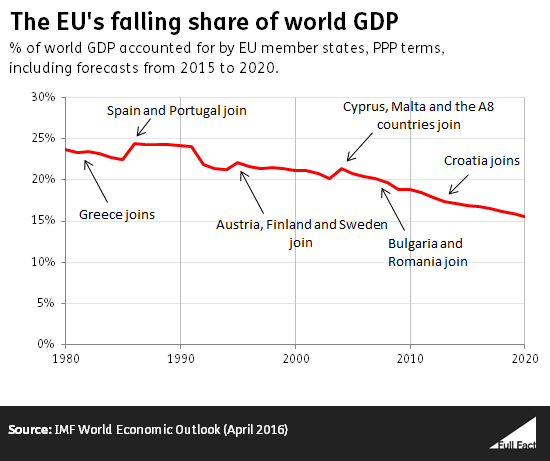
2016%20Update%20EU%20GDP%20Share.png


The above graph is demonstrating the falling SHARE of world GDP, which as others have suggested isn't wrong, but it's misleading. China's GDP has skyrocketed and developing nations grow quicker - which although any individual GDP growth can't match the big boys, 150 countries with a modest GDP growth ends up being quite big... thus as a percentage, the EU goes down. Doesn't mean doing 'badly' as such. In effect the EU's share is being eroded at both ends, but China's enormous growth, and by countess smaller growths of smaller nations.
 
Oh dear, this is hard work. Just do the maths Algarve.

Obviously I'm not as gifted as you but if I understand correctly from you and Grunge the decline in economic output in the eu is solely down to the rise of Chinese economic activity and nothing to do with the abbarition of the eu's policy on austerity in the last 7 years - Definitely a shared Nobel prize in economics arriving at your place very shortly for you and Grunge.
 
Well the point I was making was that I have read many, many discussions on this board about the impact of potential eu tariffs to be imposed on the uk without the seriously due consideration as to what the effects would be on the uk's trading position within the eu based upon the ever increasing decline of activity - which somehow is being suggested as misleading.

In economics you have a common expression which is the 'opportunity cost' of a decision and this is also what I am saying that this is not being factored into discussions. Its all very one dimensional.

The tariffs are what every other nation outside the EU has to put up with, and we could too - it's not a major inhibitor (it can't be, since others trade perfectly well) - but, our problems is, we've been drinking our coffee fully sweetened (with the tariffs) so when those tariffs are applied to our businesses, it tastes very bitter, and it costs - because all our staffing and costs are based about no tariffs. That 'adjustment' is where the pain comes from.
I was arguing that if the EU collapsed or shrank significantly (in terms of member numbers) - then the tariffs would be the least of business worries (they'd either disappear cos there is no EU, or they'd hardly be worth having, because we'd be trading directly with the other nations who'd left. And on top of that, the chances are, Europe would be a right old state of panic if the EU collapsed, thus ANYTHING could happen in that situation!
 
Obviously I'm not as gifted as you but if I understand correctly from you and Grunge the decline in economic output in the eu is solely down to the rise of Chinese economic activity and nothing to do with the abbarition of the eu's policy on austerity in the last 7 years - Definitely a shared Nobel prize in economics arriving at your place very shortly for you and Grunge.

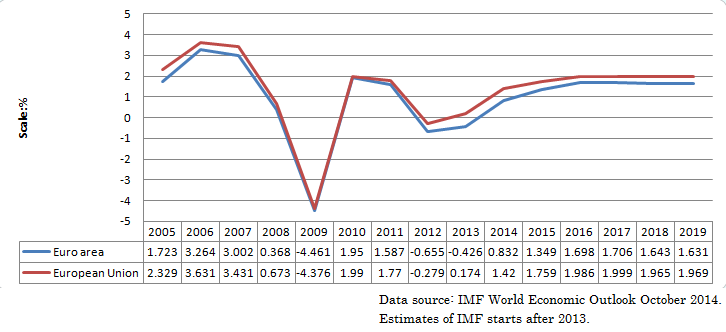
The growth hasn't declined:
Graph_of_average_growth_rate_of_EU_countries_and_Euro_zone.png


It has levelled... but the graph you were showing wasn't growth, it was as a world percentage. In world percentage terms, the EU share has declined, but the actual output hasn't.

Obviously if you go back to 2006, the rate of growth is less, but the current 'trend' isn't declining.
 
I can't believe the outers are ahead in the BM poll. Shame on your silly, nationalistic arses.
 
Obviously I'm not as gifted as you but if I understand correctly from you and Grunge the decline in economic output in the eu is solely down to the rise of Chinese economic activity and nothing to do with the abbarition of the eu's policy on austerity in the last 7 years - Definitely a shared Nobel prize in economics arriving at your place very shortly for you and Grunge.

I don't think you actually read any of my last 3 posts did you. You can't have done.

I said that the EU's performance has been nothing to write home about but that the huge drop in GDP as a % of the total is due to the meteorice rise the GDP of the developing countries over that period.

Whether the EU's performance (or lack thereof) is down to austerity or anything else, I am not even discussing. Just the maths and the fact that your chart was completely misleading.
 
You're not listening Algarve.

In the period 2005 to 2010, Brazil's GDP more than quadrupled. China has gone up by a factor of more than 10 in the last 10 years. India by so much more than 10x that I they didn't even figure in 2005.

Developed countries like those in the EU are *never* going to grow at these rates and therefore *necessarily* EU GDP will fall as a % of the world total. You're drawing completely the wrong conclusions.
How are the BRIC countries doing now?
 
Status
Not open for further replies.

Don't have an account? Register now and see fewer ads!

SIGN UP
Back
Top