Banned Tosspot
Well-Known Member
^^These two lol^^

Fees put up to pay for fat cats! FFS - I give up.
I will read the second link and revert while you look up GDP debt.
Are you for real? I know full well the differnce. We were runing at a defecit of 11 percent per annum when the tories came to power. I will spell this out. If you do that forever what happens to the national debt?
One of the most poorly punctuated and grammatically incorrect posts I have ever seen in ten years on Blue Moon.
What could possibly go wrong? When's the date?
So the fact that many universitys are all charging the top £9k and the vice chancellors salaries are going up at the same time just a coincidence? Even your guilty pleasure paper is having a pop https://www.thesun.co.uk/news/5322778/universities-vice-chancellors-pay-amounts/
You need to heed your own advice mate and don't feed the troll. The shithouse will just wind you up all night.
Do you think we can afford free education for everyone until 21? Many doing courses that are a complete waste of time. Do you not feel a move towards a trade or apprenticeship makes much more sense for many? So many people were doing worthless degrees after the millennium it was farsical.
Do you think that we can afford to slash corporation taxes by another £9billion in a race to the bottom?
Do you think we can afford to replace a nuclear war head?
Do you we can afford to spaff billions on HS2 a rail link that expands the London bubble?
Do you think that we can afford to spend £100 million on TV and radio adverts on a no.deal on 31st October that legally can't happen?
Do you think that we can afford to spend billions on a no deal brexit that will probably never happen?
Do you think that we can afford to slash corporation taxes by another £9billion in a race to the bottom? Cutting corporation tax will stimulate investment and the economy
Do you think we can afford to replace a nuclear war head? I absolutely believe we need a nuclear deterrent
Do you we can afford to spaff billions on HS2 a rail link that expands the London bubble? I believe hs2 will help reduce the north south divide
Do you think that we can afford to spend £100 million on TV and radio adverts on a no.deal on 31st October that legally can't happen? I am a firm believer in brexit and the long term benefits 100 million in the scheme of the university issue is peanuts
Do you think that we can afford to spend billions on a no deal brexit that will probably never happen? We would have got a good deal but for the surrender act
Are you for real? I know full well the differnce. We were runing at a defecit of 11 percent per annum when the tories came to power. I will spell this out. If you do that forever what happens to the national debt?
Knowing what it is and understanding what it is and its effects are two completely different things.
It is like knowing a poem by heart means you know the poem, but it does not mean you understand the poem.
If countries spend more than they get back from tax they normally have to borrow money to make up the difference, that is obvious.
Governments borrow all the time, and almost all have a national debt. It makes sense to borrow money not just to fill emergency deficits, but to pay for investment that will help make a country more productive. Many people want to lend money to governments because they are safe and secure. If you have a pension, it's a sure bet that some of your savings will have been lent to governments. I promise to the bearer on your bank notes has an immense psychological power.
This is where the national debt comes in. This is everything the government has borrowed, not just this year, but in previous years. This can go back a very long time. Osborne sanctioned the payment of the last debts owed from WW1 and I am pretty sure we will still owe money from WW2 to the Yanks under the lend lease plan, although I may be wrong on that.
If the government covers a deficit by borrowing money, then that will increase the national debt. When times are good and tax income is higher than spending, governments can pay back part of the debt and it will come down, or if the debts are considered manageable as they are they can use the extra revenue to invest. This led to the Tory phrase "didn't fix the roof whilst the sun was shining" although that phrase ignored the huge investments that had been made, it indicates that the Tories would have preferred to pay off debt.
The difference between the deficit and the national debt is crucial. The deficit is a snapshot of how the country's finances are doing in any one year. The national debt takes into account what has happened in the past too, hence the national debt is increasing.
A country with a smaller national debt can easily run a big deficit for a few years. A country with a big debt will find it harder to run a deficit as it will finds it harder and more expensive to borrow money.
Our country has had times when national debt has exceeded 200% of GDP, The Napoleonic Wars and WW2 being prime examples. They had to borrow to cover the deficit caused by those wars.
However no country can run huge deficits every year for ever. The bigger the national debt that builds up, the more expensive it is to meet interest payments. At some point it becomes more difficult and more expensive for governments to borrow extra money because people become reluctant to lend to them. The Conservative government overstated our problems with their maxed out credit nonsense, this was a purely political move aimed at cutting public spending. The bank crash of 2008 was the perfect crisis that they could exploit for ideological reasons. In fact UK debt is not that much of an issue, even now it is still lower than it was for most of the last century apart from around the end of the World Wars. Our national debt is comparable to Norway's, less than Germany and the US and more than Spain and Switzerlands. There is nothing special about our debt although the way the Government go on about it you would think impending doom is round every corner. The UK differs though to those who are worse off than ourselves in that. First more than 70 per cent of UK government debt is held within the UK by things like pension funds. It is a mistake to think that our national debt is all owed to other governments or foreign speculators. Secondly UK debt is more long-term than many other countries. On average our debts have a pay-back period of 12 years. Countries like Greece need to keep paying back debts and are forced to borrow more to make up for that. The UK does not face any problems refinancing its debts.
Governments need to borrow money all the time as previous loans need to be paid back, or simply because tax does not come in evenly over a year. Even with today's low interest rates the UK government has not had any difficulty borrowing although you never hear that from the Chancellor because it does not suit his ideological reasoning. Our debt repayments are actually lower now than they were 20 years ago.
You can eliminate the deficit by
Running a deficit of 11% as you indicated should be no problem at all to an economy such as ours and it isnt that big a deal. Mcdonell knows this and the Tories counter with magic money tree nonsense.
- Devaluation of exchange rate (make exports cheaper – imports more expensive) This is politically loaded and can lead to inflation, inflation is hated by neo-liberals.
- Reduce domestic consumption and spending on imports (e.g. tight fiscal policy/higher taxes) Again politically loaded.
- Supply side policies to improve the competitiveness of domestic industry and exports. Singapore on Thames dreamland.
Basically it is all political choice and if you baffle the population, simplify the arguments down to a basic level you can get around to building the Singapore on Thames those with Capital crave. (see point 3) the supply side measures include wage cuts, reduction of union powers, freeing the market even more etc. Supply side policies can improve the competitiveness of the economy and help make exports more attractive. This can improve the current account position, but it may take considerable time to have an effect. For example, if the government pursued a policy of privatisation and deregulation it may help to increase the efficiency of the economy because of the profit motive in the private sector. This increased efficiency would translate into lower costs of production and more exports. If Brexit happens this will be crucial for the economy according to the pro-capitalist nutjobs on the further right of the Tory party.
As Karl Marx said
"The will of the capitalist is certainly to take as much as possible"
As Cameron's book states at the start - it has been spend, spend spend for the last 12 years and there was nothing left in the pot.
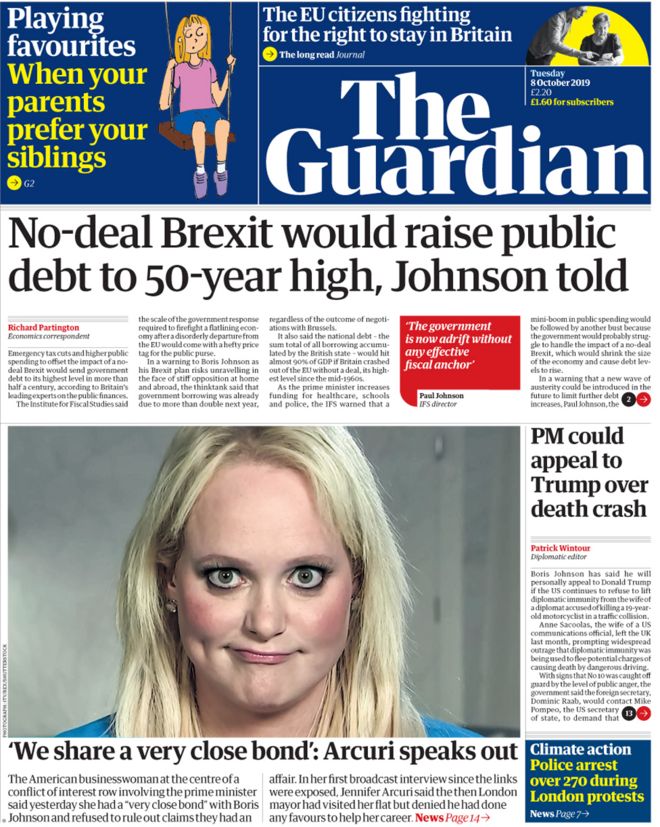
You'll love this then.....
Answer mine first. See mine below.
No deal Brexit Worsley has just gone to wax the dolphin on this.You'll love this then.....
Institute of Fiscal Studies and Citibank both reckon that the economy would be 5% bigger with a Labour government than a Tory one by 2022.
https://www.ft.com/content/7cdfa832-e908-11e9-a240-3b065ef5fc55
No deal Brexit Worsley has just gone to wax the dolphin on this.