but correctThink it was Dawkins who said that forcing religion on kids was in itself a form of abuse. But he’s an arsehole.

You are using an out of date browser. It may not display this or other websites correctly.
You should upgrade or use an alternative browser.
You should upgrade or use an alternative browser.
Religion
- Thread starter idahoblues
- Start date
this is where lord actons words of power corrupts and absolute power corrupts absolutely is never truerYou could be right. But given the nature of society, it was scarcely necessary to invent religion in order to abuse kids. Until relatively recently in our history, a father had complete power over his family. The state simply did not interfere. That religion added another layer is a strong possibility. We see it even now in certain closed societies where the 'minister' (to use a neutral term) is held to be above suspicion due to his high social status in that society.
mancity2012_eamo
Well-Known Member
I see what you are saying. In fairness I’d agree with BrianW insofar as I feel that religions developed as power structures primarily. They were a way of controlling the masses.Yes you're correct and my point is major religions may have started out as ways to abuse kids and developed from there.
They all have problems when it comes to children.
I do agree with you however that certain Christian denominations by their nature of demanding celibacy, which in itself was a control of the church’s wealth, attracted deviants and perhaps nurtured deviant behaviour because of the lack of physical intimacy.
I'm no cynic but...
Well-Known Member
- Joined
- 22 Jan 2013
- Messages
- 4,000
- Location
- True friends stab you in the front.
- Team supported
- The one and only City
And the Old Testament tells us to go forth and multiply and it also tells us that humans were given dominium over all the creatures of the world. No wonder the planet is as good as finished.Perhaps the greens have it right.
Maybe the one true religion is respect the world you live in, and be in balance with your environment, because we’re not as clever as we think we are.
mancity2012_eamo
Well-Known Member
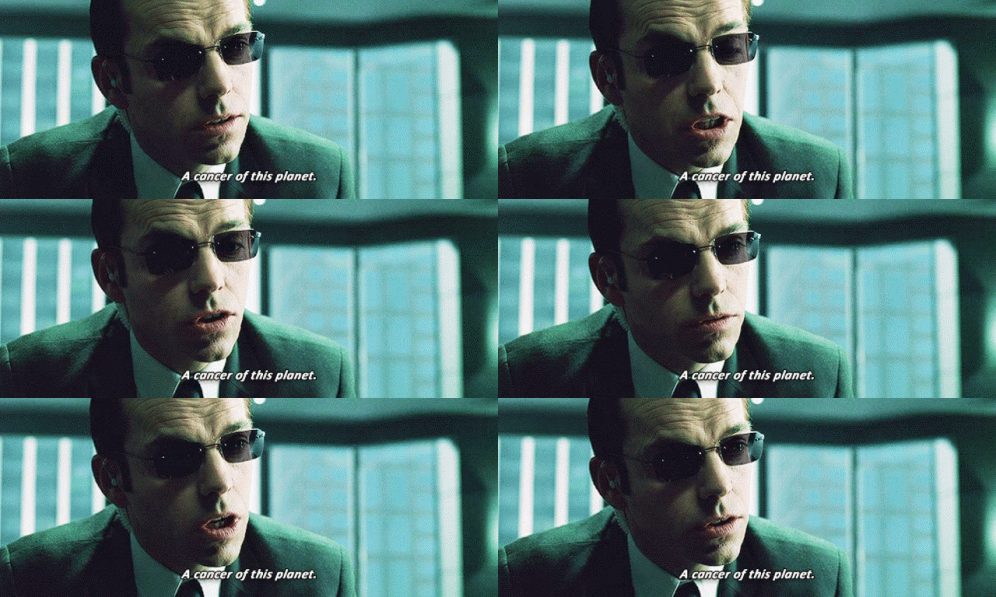
As I said previously, we are nought but a virus.And the Old Testament tells us to go forth and multiply and it also tells us that humans were given dominium over all the creatures of the world. No wonder the planet is as good as finished.
It isn't that people within religious organisations are paedophiles, it is the fact that those in the same organisation cover up their abuse so as not to tarnish the religion. They are more worried about bad press than the welfare of a child.
mancity2012_eamo
Well-Known Member
It’s bad for business.It isn't that people within religious organisations are paedophiles, it is the fact that those in the same organisation cover up their abuse so as not to tarnish the religion. They are more worried about bad press than the welfare of a child.
aguero93:20
Well-Known Member
- Joined
- 21 Oct 2013
- Messages
- 90,256
- Location
- Hunting Cats.
- Team supported
- Some gobshites in day-glo green and black.
As I said previously, we are nought but a virus.
ZenHalfTimeCrock
Well-Known Member
- Joined
- 18 Apr 2019
- Messages
- 1,593
- Team supported
- Manchester City
‘A’isha entered Muhammad’s home as his wife at a tender age; the range of years is given as between six and nine. The marriage was not consummated until she reached puberty…Child marriage was not an uncommon practice in the Arabian peninsula at this time, often being contracted for political purposes between leading families [as this one was].’Didn’t Mohammed marry a six year old?
Asma Afsaruddin (a reputable academic rather than one of those nebulous ‘Islamic scholars’ with dubious credentials) - The First Muslims pg. 66
Of course, this abhorrent practice persists in parts of the Islamic world, for example, in Afghanistan under the Taliban.
ZenHalfTimeCrock
Well-Known Member
- Joined
- 18 Apr 2019
- Messages
- 1,593
- Team supported
- Manchester City
The German based South Korean philosopher Byung-Chul Han has produced a book of essays (Capitalism and the Death Drive) that explore this very idea.
ZenHalfTimeCrock
Well-Known Member
- Joined
- 18 Apr 2019
- Messages
- 1,593
- Team supported
- Manchester City
A more interesting question is not how religion began (though it is a fascinating one - many started out in opposition to existing power structures) but why it persists as a phenomenon.
A few suggestions:
1. Lots of people still, even now, claim to have religious experiences (individual, mystical, corporate, NDE’s etc.). And without religious experiences, you wouldn’t have religions. In other words, those Pentecostal Snake Handlers obviously think they are on to something.
2. We all seek to transcend our egos. Contemplative practices like meditation and prayer - so embedded in world faiths - can help with that. Of course, a suitable drug or combination of drugs, moments like 93:20, music and art, can induce the same effect.
3. Faith - like conspiracy theories - imposes order and meaning on an otherwise chaotic, random and meaningless universe.In connection with this, Freud and Lucretius both declared that humans created gods out of fear, suggesting that if we believe that gods inflict earthquakes, floods, famine and disease on us, attempts to propitiate them through penitential prayer or sacrifice might make us feel more in control of things. Of course, the stuff to do with the afterlife also helps with fear of death.
I have one last observation: quite a few contributors to this thread seem to equate religion with monotheism.
I would therefore gently remind them that ‘God’ is a not a concern of, off the top of my head and for starters, Buddhism, Jainism, Confucianism, Taoism, Shinto or the Carvaka/Lokayata schools of ancient Indian philosophy.
There is also no scholarly consensus about what ‘religion’ actually is, and therefore likely to be no irreducible essence to the concept.
For more on that, see Wittgenstein’s helpful notion of ‘family resemblance’.
A few suggestions:
1. Lots of people still, even now, claim to have religious experiences (individual, mystical, corporate, NDE’s etc.). And without religious experiences, you wouldn’t have religions. In other words, those Pentecostal Snake Handlers obviously think they are on to something.
2. We all seek to transcend our egos. Contemplative practices like meditation and prayer - so embedded in world faiths - can help with that. Of course, a suitable drug or combination of drugs, moments like 93:20, music and art, can induce the same effect.
3. Faith - like conspiracy theories - imposes order and meaning on an otherwise chaotic, random and meaningless universe.In connection with this, Freud and Lucretius both declared that humans created gods out of fear, suggesting that if we believe that gods inflict earthquakes, floods, famine and disease on us, attempts to propitiate them through penitential prayer or sacrifice might make us feel more in control of things. Of course, the stuff to do with the afterlife also helps with fear of death.
I have one last observation: quite a few contributors to this thread seem to equate religion with monotheism.
I would therefore gently remind them that ‘God’ is a not a concern of, off the top of my head and for starters, Buddhism, Jainism, Confucianism, Taoism, Shinto or the Carvaka/Lokayata schools of ancient Indian philosophy.
There is also no scholarly consensus about what ‘religion’ actually is, and therefore likely to be no irreducible essence to the concept.
For more on that, see Wittgenstein’s helpful notion of ‘family resemblance’.
Last edited:
D
D
Deleted member 77198
Guest
You recommended me a few books (that I admittedly haven’t read yet!) last year. One was around the idea of non-theism within some ancient religions/non-religions.A more interesting question is not how religion began (though it is a fascinating one - many started out in opposition to existing power structures) but why it persists as a phenomenon.
A few suggestions:
1. Lots of people still, even now, claim to have religious experiences (individual, mystical, corporate, NDE’s etc.). And without religious experiences, you wouldn’t have religions. In other words, those Pentecostal Snake Handlers obviously think they are on to something.
2. We all seek to transcend our egos. Contemplative practices like meditation and prayer - so embedded in world faiths - can help with that. Of course, a suitable drug or combination of drugs, moments like 93:20, music and art, can induce the same effect.
3. Faith - like conspiracy theories - imposes order and meaning on an otherwise chaotic, random and meaningless universe.In connection with this, Freud and Lucretius both declared that humans created gods out of fear, suggesting that if we believe that gods inflict earthquakes, floods, famine and disease on us, attempts to propitiate them through penitential prayer or sacrifice might make us feel more in control of things. Of course, the stuff to do with the afterlife also helps with fear of death.
I have one last observation: quite a few contributors to this thread seem to equate religion with monotheism.
I would therefore gently remind them that ‘God’ is a not a concern of, off the top of my head and for starters, Buddhism, Jainism, Confucianism, Taoism, Shinto or the Carvaka/Lokayata schools of ancient Indian philosophy.
There is also no scholarly consensus about what ‘religion’ actually is, and therefore likely to be no irreducible essence to the concept.
For more on that, see Wittgenstein’s helpful notion of ‘family resemblance’.
I remember we talked about the Rig Veda in Hinduism where acceptance of possible non-theism was a key part of early Hinduism 1,500 years before the story of Christ was written.
A lot of the Eastern religions are more about understanding humans, the world, the universe than they are strictly about us all being here because of a god. I think we just lack being exposed to those religions because of where we are in the world and how strict on theist and creationist thought the Abrahamic religions that surround us are.
Saying that, earlier Islam in Central Asia (Uzbekistan) had a Renaissance of mathematical and scientific thought (as well as an acceptance of drinking alcohol) before the European Renaissance occurred. In fact it was the Silk Road, that I mentioned a few pages ago, that brought the already existing Asian Renaissance to Europe and brought us out of the Dark Ages. A lot of Islam today concentrates far less on mathematical and scientific thought (and there’s a lack of acceptance of drinking alcohol, I’ve found my Muslim mates who do drink are all secular/non-practising Muslims… which itself is frowned upon within Islam).
Last edited by a moderator:
ali benarbia's studs
Well-Known Member
Psalm 50
line 22 is lovely......Psalm 50
Grassland Blue
Well-Known Member
Religion can be a good thing, even though much of what is written is utter tripe.You recommended me a few books (that I admittedly haven’t read yet!) last year. One was around the idea of non-theism within some ancient religions/non-religions.
I remember we talked about the Rig Veda in Hinduism where acceptance of possible non-theism was a key part of early Hinduism 1,500 years before the story of Christ was written.
A lot of the Eastern religions are more about understanding humans, the world, the universe than they are strictly about us all being here because of a god. I think we just lack being exposed to those religions because of where we are in the world and how strict on theist and creationist thought the Abrahamic religions that surround us are.
Saying that, earlier Islam in Central Asia (Uzbekistan) had a Renaissance of mathematical and scientific thought (as well as an acceptance of drinking alcohol) before the European Renaissance occurred. In fact it was the Silk Road, that I mentioned a few pages ago, that brought the already existing Asian Renaissance to Europe and brought us out of the Dark Ages. A lot of Islam today concentrates far less on mathematical and scientific thought (and there’s a lack of acceptance of drinking alcohol, I’ve found my Muslim mates who do drink are all secular/non-practising Muslims… which itself is frowned upon within Islam).
It is a tool to 'keep us in our place'.
However it does give us a sense of community, a moral code and comfort in difficult times.
Some fabulous architecture only exists because of 'gods' and religion too.
As for me, I think the nearest 'religion' to reflect my beliefs would be Tao/Daoism.
JOGAMIGMOG
Well-Known Member
- Joined
- 6 Jun 2006
- Messages
- 7,185
- Location
- Round at Kate Winslet's
- Team supported
- Manchester City, England and Levante Union Deportiva
I was cycling through Europe last summer and I found comfort from the countless crosses of Jesus which were along the roadside. I am not religious as such but it was nice to know he was there watching over those who travelled by.
Very good.I was cycling through Europe last summer and I found comfort from the countless crosses of Jesus which were along the roadside. I am not religious as such but it was nice to know he was there watching over those who travelled by.

BrianW
Well-Known Member
- Joined
- 6 Mar 2006
- Messages
- 6,594
- Team supported
- There's Only One City
It occurs to me that religion is a bit like a library or indeed the internet.
What you get out of it is largely down to you.
And just as some people don't need a library or the internet, some people don't need any form of religion.
I wish I could articulate my real feelings about religion. I don't have the necessary command of words, but I do find certain churches deeply spiritual places. Others are just like an office or a pub. Nothing special.
Ultimately, I believe there is something 'bigger' than us. But I also feel we can no more fully understand it than an ant can understand me.
Religion is capable of being abused because all humans are fallible and a minority are wicked.
What you get out of it is largely down to you.
And just as some people don't need a library or the internet, some people don't need any form of religion.
I wish I could articulate my real feelings about religion. I don't have the necessary command of words, but I do find certain churches deeply spiritual places. Others are just like an office or a pub. Nothing special.
Ultimately, I believe there is something 'bigger' than us. But I also feel we can no more fully understand it than an ant can understand me.
Religion is capable of being abused because all humans are fallible and a minority are wicked.
ZenHalfTimeCrock
Well-Known Member
- Joined
- 18 Apr 2019
- Messages
- 1,593
- Team supported
- Manchester City
Sunday services again today. So take care while you are out and about.

ZenHalfTimeCrock
Well-Known Member
- Joined
- 18 Apr 2019
- Messages
- 1,593
- Team supported
- Manchester City
Been preoccupied with other things for a few days so no time to reply until now. Haven't read it yet though it looks like it is very well-written but a while back I acquired a book on this: S. Frederick Starr's Lost Enlightenment. Hopefully, will get around to it soon.Saying that, earlier Islam in Central Asia (Uzbekistan) had a Renaissance of mathematical and scientific thought (as well as an acceptance of drinking alcohol) before the European Renaissance occurred. In fact it was the Silk Road, that I mentioned a few pages ago, that brought the already existing Asian Renaissance to Europe and brought us out of the Dark Ages. A lot of Islam today concentrates far less on mathematical and scientific thought (and there’s a lack of acceptance of drinking alcohol, I’ve found my Muslim mates who do drink are all secular/non-practising Muslims… which itself is frowned upon within Islam).