Coronavirus (2021) thread

Status
Not open for further replies.
With the prospects of new vaccines , anti viral treatments and now faster tests 2022 looks promising? It can't be any worse fingers crossed
North West tonight reported that Lancaster University have completed a successful lab based trial on a nasal spray covid vaccine, looking to start human trials later this year/ early next year. Hopefully available within twelve months.
 
North West tonight reported that Lancaster University have completed a successful lab based trial on a nasal spray covid vaccine, looking to start human trials later this year/ early next year. Hopefully available within twelve months.
Excellent..I think a few countries have a nasal spray in the pipeline..
 
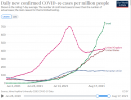
You can understand why - infections rising exponentially, already above our 3rd wave peak with no sign of slowing yet. Death rate is double ours already and rising with cases too.

With a couple of others for comparison:

View attachment 24043

And from the same article "If things did not improve, "we will get to a lockdown like the first and second ones, where we do not go farther than 100 meters from our houses".

It just seems like a completely never ending nightmare. Vaccines were the route to normality, now its the boosters, what's next? The next booster after that? Not having a dig at you Roubaix, by any means, but this has serious potential to be extremely counter productive because I imagine many many people will read that and wonder what the fuck the point is in bothering to get vaccinated. And I don't mean for the vulnerable, but everyone else.

Israel were the trend setters for a positive outlook during a bleak British winter, seeing what's happening there now would make people feel like completely giving up, especially if such tight restrictions are reintroduced.
 
And from the same article "If things did not improve, "we will get to a lockdown like the first and second ones, where we do not go farther than 100 meters from our houses".

It just seems like a completely never ending nightmare. Vaccines were the route to normality, now its the boosters, what's next? The next booster after that? Not having a dig at you Roubaix, by any means, but this has serious potential to be extremely counter productive because I imagine many many people will read that and wonder what the fuck the point is in bothering to get vaccinated. And I don't mean for the vulnerable, but everyone else.

Israel were the trend setters for a positive outlook during a bleak British winter, seeing what's happening there now would make people feel like completely giving up, especially if such tight restrictions are reintroduced.
I think we have now proved the case that lockdowns, unless they’re never actually lifted, don’t have any real effect on the course of the virus. They might slow things down a little but, once you lift restrictions, the virus just goes on and does it’s thing, whilst lockdown creates a myriad of problems, aside from kicking the can down the road.

We need to start looking at Covid in the context of competing co-morbidities, and with regard to patient life expectancy and quality of life, instead of treating like a stand alone illness that will take everyone off to an early grave.
 
Great to see this thread getting smaller by the day. Definitely can see and feel people getting by now and accepting a certain amount of risk. As we should
It's just dragged on for so long that you can do nothing else. Key moments ahead are the vaccine boosters, trials of new vaccines, and the start of the new school term.

We're at 30,000 cases a day and rising and 95% of adults have antibodies. That tells me we need to move beyond these vaccines either through a 3rd dose which buys time, or through more specific vaccines which could take us back to where we were when the vaccines were first introduced. Trial results will be key. What works? We should be careful not to just go with what suits Astrazeneca and Pfizer. We should be looking to end this and not lock ourselves into a cycle of vaccination.
 
Last edited:
And from the same article "If things did not improve, "we will get to a lockdown like the first and second ones, where we do not go farther than 100 meters from our houses".

It just seems like a completely never ending nightmare. Vaccines were the route to normality, now its the boosters, what's next? The next booster after that? Not having a dig at you Roubaix, by any means, but this has serious potential to be extremely counter productive because I imagine many many people will read that and wonder what the fuck the point is in bothering to get vaccinated. And I don't mean for the vulnerable, but everyone else.

Israel were the trend setters for a positive outlook during a bleak British winter, seeing what's happening there now would make people feel like completely giving up, especially if such tight restrictions are reintroduced.

Indeed, it's not a good position to see Israel in. But we shouldn't just ignore it and cross our fingers, we should think about how to avoid a spike in hospitalisation and death here which would end up with restrictions back. We're only 1-2 doublings away from a very significant health service impact.

First, we absolutely need to get as many people as possible vaccinated. We're not even trying, with still no rollout in 12-15yos.

There's not much point in general restrictions to protect people once we have as many people as possible vaxxed as it's just delaying the inevitable then. But we do need to keep infection below levels which cause a significant societal impact - health service primarily.

So second, I think we should consider measures to dampen spikes if and when they occur. I'm no expert, but that could include things like ventilation and air filtration systems in closed spaces (schools, nightclubs, offices...), masking where crowding is inevitable (public transport) and other things like that. This has been pushed for by some of the scientific community for a long time now, but I don't see any evidence of govt action on it.

And third, we need to see if delta specific vaccines can help improve efficacy, particularly against onward transmission.

Even in Israel, all the evidence is that without vaccines, it would be far worse. Perhaps 10x worse on deaths.

 
Indeed, it's not a good position to see Israel in. But we shouldn't just ignore it and cross our fingers, we should think about how to avoid a spike in hospitalisation and death here which would end up with restrictions back. We're only 1-2 doublings away from a very significant health service impact.

First, we absolutely need to get as many people as possible vaccinated. We're not even trying, with still no rollout in 12-15yos.

There's not much point in general restrictions to protect people once we have as many people as possible vaxxed as it's just delaying the inevitable then. But we do need to keep infection below levels which cause a significant societal impact - health service primarily.

So second, I think we should consider measures to dampen spikes if and when they occur. I'm no expert, but that could include things like ventilation and air filtration systems in closed spaces (schools, nightclubs, offices...), masking where crowding is inevitable (public transport) and other things like that. This has been pushed for by some of the scientific community for a long time now, but I don't see any evidence of govt action on it.

And third, we need to see if delta specific vaccines can help improve efficacy, particularly against onward transmission.

Even in Israel, all the evidence is that without vaccines, it would be far worse. Perhaps 10x worse on deaths.

IMO we should make a lot of these high risk things open to double vaccinated people only.

And that includes the football.

With exceptions being if some people can’t have vaccines due to allergies etc.
 
Indeed, it's not a good position to see Israel in. But we shouldn't just ignore it and cross our fingers, we should think about how to avoid a spike in hospitalisation and death here which would end up with restrictions back. We're only 1-2 doublings away from a very significant health service impact.

First, we absolutely need to get as many people as possible vaccinated. We're not even trying, with still no rollout in 12-15yos.

There's not much point in general restrictions to protect people once we have as many people as possible vaxxed as it's just delaying the inevitable then. But we do need to keep infection below levels which cause a significant societal impact - health service primarily.

So second, I think we should consider measures to dampen spikes if and when they occur. I'm no expert, but that could include things like ventilation and air filtration systems in closed spaces (schools, nightclubs, offices...), masking where crowding is inevitable (public transport) and other things like that. This has been pushed for by some of the scientific community for a long time now, but I don't see any evidence of govt action on it.

And third, we need to see if delta specific vaccines can help improve efficacy, particularly against onward transmission.

Even in Israel, all the evidence is that without vaccines, it would be far worse. Perhaps 10x worse on deaths.
I think with the measures you have suggested we are missing the crux of this virus and how it spreads. We constantly hear of the need to put in measures that affect everyone but no-one ever considers measures that target the heart of transmission.

This virus predominately spreads in homes and in particular through sustained close contact with others. The only measures I would ever consider are those that target this fact, I.E, restrict how many people can meet. This is the only thing that truly makes a difference to case numbers.

Your chances of catching the virus on a plane is 1 in 40,000 but you have to wear a mask on a plane. Your chance of catching the virus in a supermarket is 1 in 80,000 and until recently we had social distancing and mask requirements in supermarkets. We have even seen nightclubs reopen and generally there has not been any real impact on cases.

Your chances of catching the virus in the home are almost 100% if you come into close contact with someone with the virus. We've just seen this with the large case rise a month or so back which was driven by people meeting at home for the Euros. It's silly that we wear masks in supermarkets where the risk is tiny but how many people wear masks when visitors come where the risk is huge?

If absolutely necessary we can halt transmission completely over the winter if we introduce measures to kerb people meeting up in households, the rest really doesn't matter.
 
I think with the measures you have suggested we are missing the crux of this virus and how it spreads. We constantly hear of the need to put in measures that affect everyone but no-one ever considers measures that target the heart of transmission.

This virus predominately spreads in homes and in particular through sustained close contact with others

Good point. I guess I'm coming from the perspective that the last thing we want to do is impact people's freedom to meet up in this sort of way, whereas what I would see as much less impactful measures of the sort I was suggesting might give us a better chance of avoiding those sorts of restrictions.

More testing and support for people testing positive to isolate is another such measure, IMV.

Of course, what I think is less impactful might not be the same as what you think.

Your chances of catching the virus on a plane is 1 in 40,000

Do you have a source for that? It would depend on community prevalence.

I've seen research suggesting far higher, even pre-Delta. For instance:

" Among the 16 persons in whom SARS-CoV-2 infection was detected, 12 (75%) were passengers seated in business class along with the only symptomatic person (attack rate 62%). Seating proximity was strongly associated with increased infection risk"


There seems to be various dodgy stuff pushed by some airlines minimising the risks.
 
Status
Not open for further replies.

Don't have an account? Register now and see fewer ads!

SIGN UP
Back
Top