Electric cars

I see the anti EV brigade are out in force.
Not sure why they spend the time and effort to post. Who are they trying to influence here?

I suppose bi-curious people need to "engage" in some way... ;)
Not sure if I come across as anti-EV, but I'm not. I've driven loads if them (end of lease back to auction sites) and liked all the ones I'd ever want to own, ie not the Fiat 500 or Renault Zoe.
I am however anti-enforced EV due to the lack of a network of cheap public charge points,
Typical overnight electricity rates are 13-16p/kWh and cheaper prices are available for specific EV tariffs, so around 3-4p/mile for a typical EV doing 4 miles per kW. The cheapest public chargers are around 45p/kWh so around 11p/mile ,with fast chargers (still much slower than a fuel pump) at 70-85p/kWh so 18-20p/mile. - Public charge figures from a site called love electric so unlikely to be ant-EV.
We've spent years baulking at using motorway fuel as it's up to 20% more expensive than supermarket fuel, but EV owners unable to charge at home are expected to pay 200-300% more for EV fuel than those who can tuck their cars up with an overnight timer.
The above also applies to plug-in hybrids but here the comparisons are muddied still further by the inability to find typical mpg figures for PHEVs running in petrol/diesel mode once the battery is flat. The standard formula is as much use as a chocolate teapot because the test cycle always assumes some running in EV mode. For example my cousin's husband has only put £90 of petrol in his Lexus RX450 PHEV over 6,000 miles as he rarely goes long distances and can charge at home. That would cost me around £600 (pre-war prices) in my much lighter self-charging hybrid.
 
Not sure if I come across as anti-EV, but I'm not. I've driven loads if them (end of lease back to auction sites) and liked all the ones I'd ever want to own, ie not the Fiat 500 or Renault Zoe.
I am however anti-enforced EV due to the lack of a network of cheap public charge points,
Typical overnight electricity rates are 13-16p/kWh and cheaper prices are available for specific EV tariffs, so around 3-4p/mile for a typical EV doing 4 miles per kW. The cheapest public chargers are around 45p/kWh so around 11p/mile ,with fast chargers (still much slower than a fuel pump) at 70-85p/kWh so 18-20p/mile. - Public charge figures from a site called love electric so unlikely to be ant-EV.
We've spent years baulking at using motorway fuel as it's up to 20% more expensive than supermarket fuel, but EV owners unable to charge at home are expected to pay 200-300% more for EV fuel than those who can tuck their cars up with an overnight timer.
The above also applies to plug-in hybrids but here the comparisons are muddied still further by the inability to find typical mpg figures for PHEVs running in petrol/diesel mode once the battery is flat. The standard formula is as much use as a chocolate teapot because the test cycle always assumes some running in EV mode. For example my cousin's husband has only put £90 of petrol in his Lexus RX450 PHEV over 6,000 miles as he rarely goes long distances and can charge at home. That would cost me around £600 (pre-war prices) in my much lighter self-charging hybrid.
At the moment the government must be working out how to recover all the tax it gets from petrol sales as ev’s become the majority of cars on the road. Many ‘private’ charging points already charge rates that bring the ev cost per mile close to the petrol cost per mile particularly on motorways, and presumably they are not paying anything like the petrol tax. Eventually the cost per mile including tax must come close to the ‘normal’ petrol cost. At the moment ev’s are benefitting from this tax inequality, for those who charge at home overnight. It is also likely that off peak electricity usage will increase as more electric cars come on the road so in the longer term the benefits of ev’s will be down to their inherent plus points rather than their economics.
 
At the moment the government must be working out how to recover all the tax it gets from petrol sales as ev’s become the majority of cars on the road. Many ‘private’ charging points already charge rates that bring the ev cost per mile close to the petrol cost per mile particularly on motorways, and presumably they are not paying anything like the petrol tax. Eventually the cost per mile including tax must come close to the ‘normal’ petrol cost. At the moment ev’s are benefitting from this tax inequality, for those who charge at home overnight. It is also likely that off peak electricity usage will increase as more electric cars come on the road so in the longer term the benefits of ev’s will be down to their inherent plus points rather than their economics.

Petrol will run out one day, so EV and other forms of transport will eventually take over. Petrol and Diesel cars are gradually heading towards extinction and the scrap yards or collectors items that can’t be driven in the future.
 
Anyone use Eon next drive. Just had my new rates off octopus and a chance to fix for 12 months. Had a quick Google and Eon is cheaper per standing charge, cheaper on day rate but 9p kW against 8p for octopus. Anyone know how easy it is to use as I've never had any issues with charging on octopus.
 
Anyone use Eon next drive. Just had my new rates off octopus and a chance to fix for 12 months. Had a quick Google and Eon is cheaper per standing charge, cheaper on day rate but 9p kW against 8p for octopus. Anyone know how easy it is to use as I've never had any issues with charging on octopus.
1p difference.

Why bother?
 
I wish I needed a new car, I would go EV every time now. Unfortunately mine is nearly 8 years old and only just coming up to 30k miles. Since retirement the mileage is way down as we also live central to a market town so walk to the shops most days. I simply can't justify binning a perfectly good car to save what would be a few £ for the miles we actually do.
 
I had a look at the Kia EV2 yesterday. Very nice. It doesn’t blow your socks off, but it’s a nice car. Loads of head room, roomy cabin, plenty of natural light inside the cabin, good visibility, high seating position, nice dashboard layout, plenty of leg room, quality cabin materials, a big boot, much larger inside than it looks from the outside, etc. I will definitely test drive it. I’m waiting for the bigger battery model due out later this year which gets the government ECG grant of £3,750 off the list price. I’m also waiting to test drive the ID.Polo which is due out later this year as well.

The UK government's Electric Car Grant (ECG), running until 2028/29, provides up to £3,750 off new, qualifying electric vehicles (EVs) priced under £37,000 to promote sustainable transport. The grant is automatically applied by dealers for qualifying models—including various Renault, Peugeot, and Vauxhall cars—with additional smaller discounts of up to £1,500 available, depending on vehicle emissions.
 
I keep seeing EV3s all of a sudden up here, lovely looking and I do like the look of the interior when I've had a pokey.

I looked at the EV3 as well, but the EV2 is big enough for me as a single person. I can understand why families buy the EV3. Very nice.
 
Drove the EV6 last week, very nice but I prefer the Ionic 5.
Also drove a plug-in Hyundai Santa Fe which went quite went for such a big lump.
 
  • Like
Reactions: jrb
Drove the EV6 last week, very nice but I prefer the Ionic 5.
Also drove a plug-in Hyundai Santa Fe which went quite went for such a big lump.

I will be test driving that as well. I think it’s a great car.

Did you test drive the old or new version?

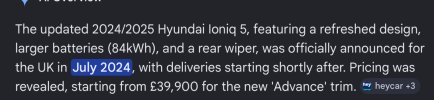
The new version has the windscreen wiper on the back window, as well as other upgrades nd improvements.
 
I will be test driving that as well. I think it’s a great car.

Did you test drive the old or new version?

The new version has the windscreen wiper on the back window, as well as other upgrades nd improvements.
Depends when the new one came out. Most cars I drive are end of lease and going to auction sites, so are around three years old.
 
I had a look at the Kia EV2 yesterday. Very nice. It doesn’t blow your socks off, but it’s a nice car. Loads of head room, roomy cabin, plenty of natural light inside the cabin, good visibility, high seating position, nice dashboard layout, plenty of leg room, quality cabin materials, a big boot, much larger inside than it looks from the outside, etc. I will definitely test drive it. I’m waiting for the bigger battery model due out later this year which gets the government ECG grant of £3,750 off the list price. I’m also waiting to test drive the ID.Polo which is due out later this year as well.

The UK government's Electric Car Grant (ECG), running until 2028/29, provides up to £3,750 off new, qualifying electric vehicles (EVs) priced under £37,000 to promote sustainable transport. The grant is automatically applied by dealers for qualifying models—including various Renault, Peugeot, and Vauxhall cars—with additional smaller discounts of up to £1,500 available, depending on vehicle emissions.
What’s the Ev2 like in comparison to Ev3, size wise, JRB? We’ll be looking for electric new car later this year and I do like the EV3 reviews
 

Don't have an account? Register now and see fewer ads!

SIGN UP
Back
Top